Company News

Hunan Great Steel Pipe Co., Ltd
drill pipe,ERW steel pipe manufacturer,api 51 line pipe

Puncher of Seamless Steel Pipe

Date: 2023-05-12
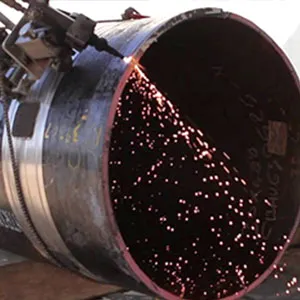
Puncher of Seamless Steel Pipe Production of hot-rolled seamless tube perforation is the most important step of deformation, its mission is to wear a solid tube rolled into a hollow tube. According to the structure and deformation characteristics piercing process of piercing machine can be divided into conventional perforating method: oblique piercing, piercing push and pressure perforation, piercing and oblique most widely used, the shape of the rotary piercing machine rolls have roll, bacteria formula (cone) and disc are three type piercing mill rolling mill rolls for use in small, while large units using bacteria type piercer rolls. Disc punch seldom used. Regardless of the roll shape how, in order to ensure the tube bite and achieve piercing process has perforated cone (roll inlet cone), grinding mill cone (roll outlet cone) and roll rolled strip (excessive portion of the inlet cone and the outlet cone between )composition. Piercer roll use a combination of rollers and the structure of the roller sleeve, both of direct interference or a combination of interference plus key combination. Thus, when the roll scrap, rollers can continue to reuse, to reduce tooling costs. Small punch roller material more choice of 45 or 40Cr, quenched and tempered. Large punch rollers multi 42CrMo, quenching and tempering. Roll material manufacturers currently using more complex, some manufacturers use 45, 55 and so on forging high-quality carbon structural steel. Some manufacturers use 50Mn, 65Mn, 70Mn, 70Mn2Mo, 60CrMnMo alloy cast or forged; hardness range requirements are inconsistent, and some require HB180-220, some require HB220-260. In order to increase the bite of the large perforated roller general processing depth of 0.8 ~ 1.2mm mesh pattern of the inlet cone. Comprehensive domestic and foreign manufacturers of material selection and usage, I think: the choice of casting roll punch 50Mn, 60CrMnMo carbon steel and other materials more appropriate, one has good strength and wear resistance, the second is applied to each rolling kinds of material pipe. Hardness Control in HB200-240 more reasonable. Post time: May-12-2023

Latest news list

  • FBE steel pipe field joint coating,FBE pipe welding protection,field joint coating,FBE coating repair,FBE field joint inspection
    FBE (fusion-bonded epoxy) coating provides external corrosion protection for steel pipes used in pipeline projects,However,during pipeline construction,the coating near pipe ends must be protected while individual pipe sections are joined by welding,The exposed joint area then requires a suitable field joint coating system,If this work is not properly controlled,damage or poor bonding at the joint can compromise the continuity of the pipeline's corrosion protection,Protecting the factory coating and applying the correct field joint system are therefore important parts of pipeline construction,
  • how to choose FBE coated steel pipe,FBE pipe selection,FBE coated pipeline requirements,FBE coated steel pipe size,FBE coated steel pipe purchase
    Selecting FBE coated steel pipes for a pipeline project involves more than specifying pipe diameter,wall thickness and coating thickness,Buyers must consider the base pipe,coating system,operating environment,installation conditions and inspection requirements as one coordinated package,A well-defined purchase specification helps prevent material mismatches,coating defects and documentation gaps before production begins,The following points provide a practical checklist for engineers,EPC contractors and procurement teams,
  • FBE coating and cathodic protection,FBE coated steel pipe,external pipeline corrosion control,cathodic protection monitoring,FBE coating disbondment
    Buried steel pipelines are exposed to moisture,soil chemicals and other environmental conditions that can cause external corrosion,To reduce this risk,pipeline projects commonly combine external fusion-bonded epoxy (FBE) coating with cathodic protection (CP),Although both methods help protect steel against corrosion,they work in different ways,FBE coating provides a physical barrier between the pipe surface and its surroundings,while cathodic protection uses an electrochemical process to reduce corrosion at exposed areas,Their effectiveness depends on proper design,installation,inspection and long-term monitoring,
  • FBE coated steel pipe quality control,FBE coating inspection,FBE coating thickness measurement,FBE pipe inspection,FBE coating quality control
    The quality of an FBE (Fusion Bonded Epoxy) coated steel pipe cannot be judged by its appearance alone,A smooth coating surface does not necessarily mean that the coating has achieved the required thickness,adhesion,or curing condition,For pipeline applications,quality control starts with the incoming bare steel pipe and continues through surface preparation,coating application,curing,and final inspection,Each stage should follow an approved procedure and the requirements specified for the project,A documented inspection process also allows buyers to verify that the supplied pipes meet the agreed technical requirements,
  • FBE coated steel pipes for buried pipelines,buried pipeline corrosion protection,FBE coated steel pipe installation
    FBE (Fusion Bonded Epoxy) coating is widely used to protect steel pipes against external corrosion in buried pipeline systems,It forms a protective barrier between the steel surface and the surrounding soil,However,coating performance depends on more than the quality of the factory-applied layer,Soil conditions,transportation,installation,field joint protection and cathodic protection all affect the long-term integrity of a buried pipeline,A reliable protection strategy should address these factors before the pipe is placed underground,

Find what you need ?

close
We use cookies and other tracking technologies to improve your browsing experience on our website, to show you personalized content and targeted ads, to analyze our website traffic, and to understand where our visitors are coming from.