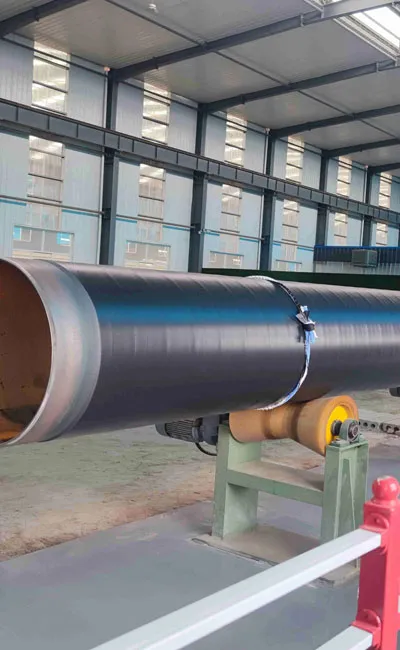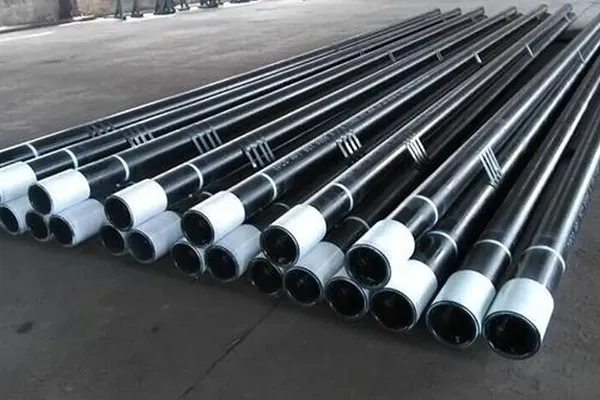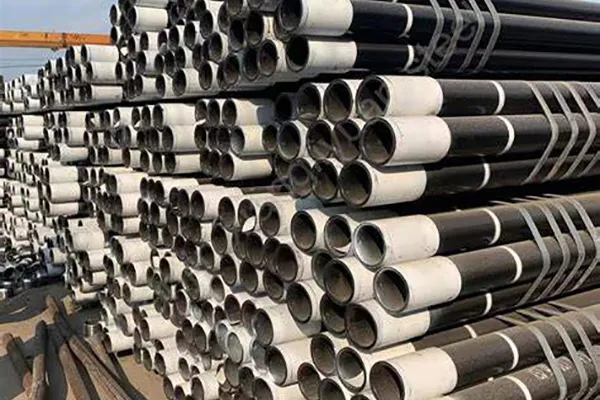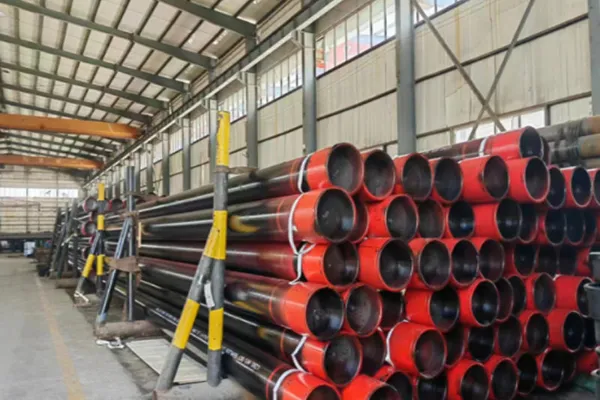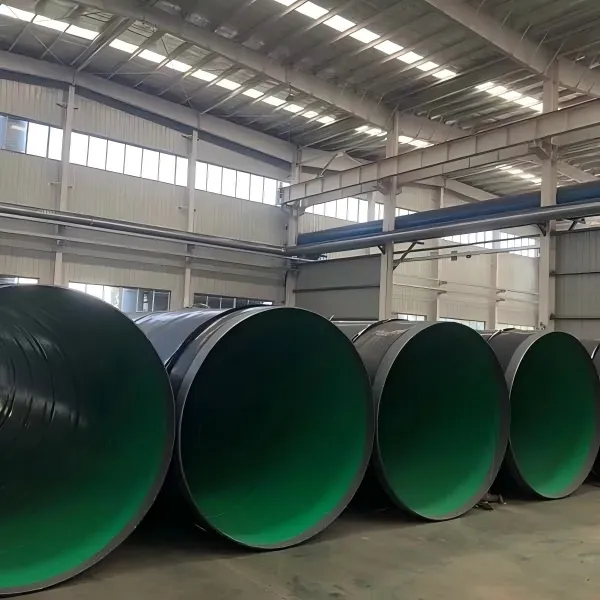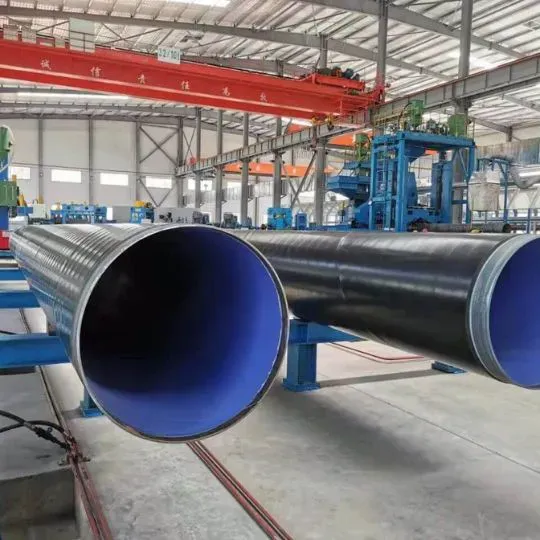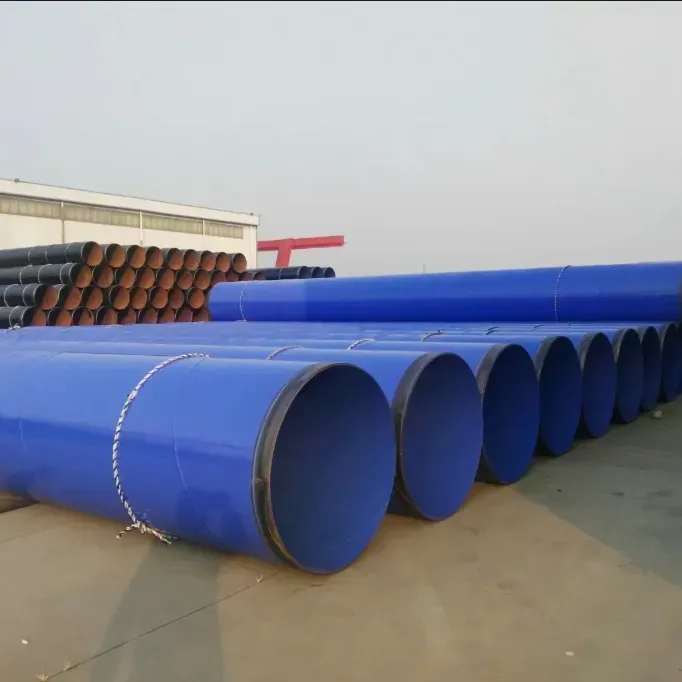

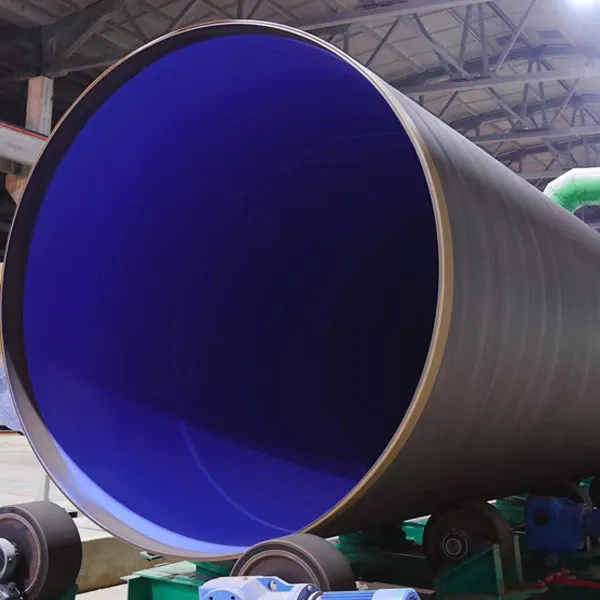
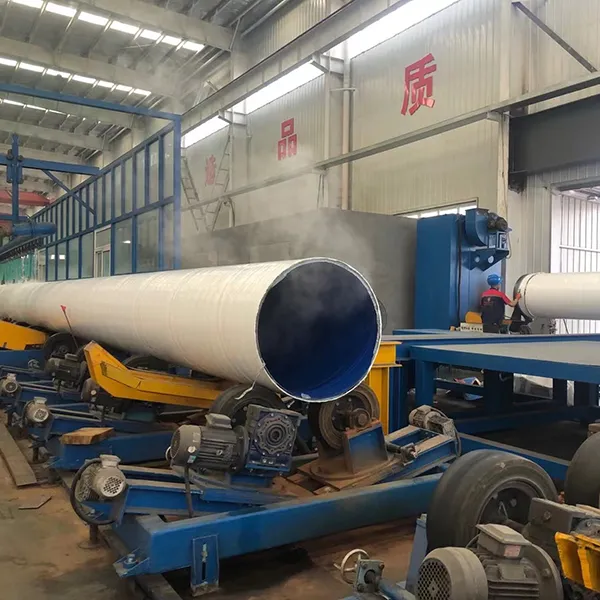
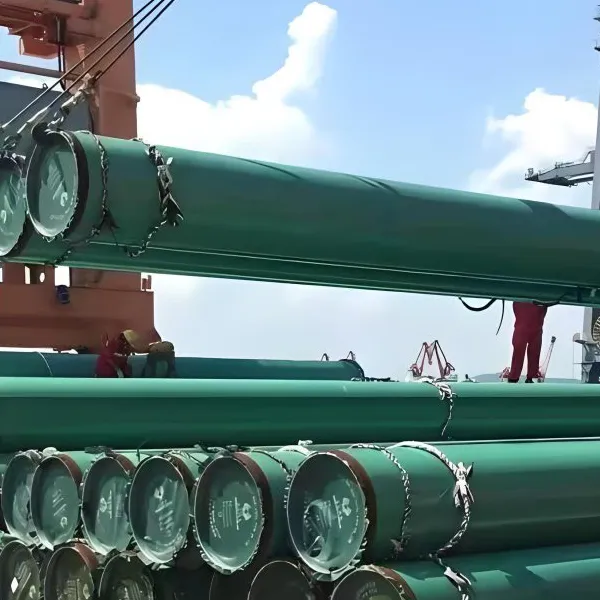
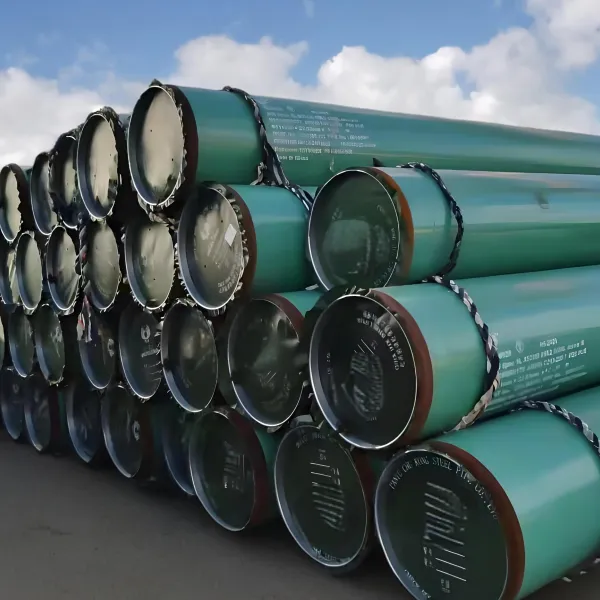
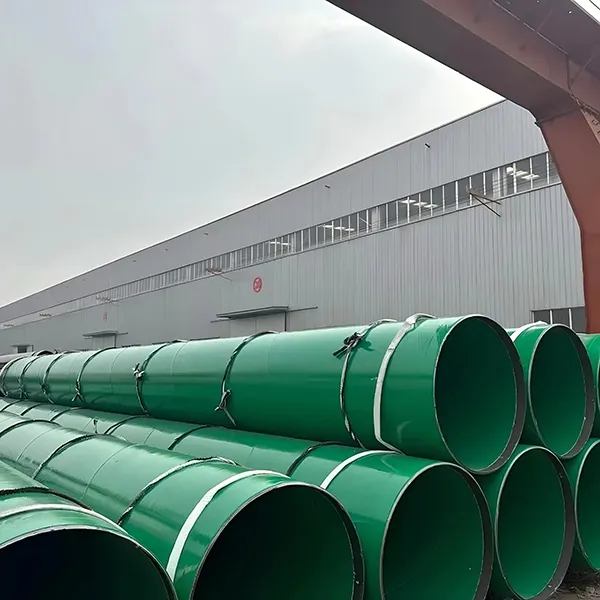
FBE Steel Pipe (Fusion Bonded Epoxy Coated Steel Pipe)is a high-performance anti-corrosion steel pipe manufactured by applying a thermosetting epoxy powder coating to the surface of a steel pipe through an electrostatic spraying and high-temperature curing process. Upon contact with the preheated steel substrate, the epoxy powder melts, flows, and chemically reacts to form a solid, continuous, and strongly adherent protective film, offering exceptional resistance to corrosion, abrasion, moisture, soil electrolytes, and cathodic disbondment. Unlike traditional solvent-based liquid coatings, FBE is solvent-free, eliminating shrinkage defects due to evaporation and significantly reducing porosity in the final film while being environmentally safe.
FBE coated pipes are available in three main configurations.
1. Single-layer FBE (350–500 µm) provides standard anti-corrosion protection for buried pipelines in moderate environments.
2. Dual-layer FBE adds a second epoxy layer or an abrasion-resistant overlay (ARO) for enhanced mechanical protection and impact resistance in severe conditions.
3. 3-layer FBE system combines an FBE primer, an adhesive layer, and a polyethylene or polypropylene topcoat, offering comprehensive protection similar to 3LPE/3LPP coatings. Single-layer FBE coatings protect buried pipelines against corrosion and mechanical damage with an average layer thickness of 400 to 500 µm, while dual-layer systems can be applied to total thicknesses of 600 µm or more.
Applications:FBE coated pipes are widely used across multiple industries.
1. Oil and gas pipelines rely on FBE for corrosion protection in buried, subsea, and onshore transmission systems, providing durable barrier against moisture, soil chemicals, and corrosive electrolytes.
2. Water transmission and distribution systems use FBE-coated pipes to ensure safe, clean water transport, with FBE coatings certified for potable water contact.
3. Natural gas distribution networks, wastewater systems, industrial piping in corrosive environments, petrochemical plants, chemical processing lines, refinery process lines, geothermal reinjection systems, steam transmission pipelines, mining slurry transport, heating networks, and fire sprinkler pipe networks all benefit from the superior adhesion, mechanical durability, and long-term corrosion resistance provided by FBE coatings.
The FBE Steel Pipe is manufactured to precise dimensional, coating, and mechanical specifications. Below are the detailed specification tables.
|
Parameter |
Range |
Tolerance / Notes |
|
Outside Diameter (OD) |
21.3 mm – 3000 mm (½″ – 118″) |
Custom diameters available |
|
Wall Thickness (WT) |
2.0 mm – 50 mm |
±10% of nominal |
|
Length |
6 m / 12 m / 12.5 m / 18 m |
Exact cut lengths available (0.5–18 m) |
|
Pipe Types |
LSAW, SSAW, ERW, Seamless |
Base material varies by application |
|
Steel Grades (API 5L) |
Gr.B, X42, X46, X52, X56, X60, X65, X70 (PSL1/PSL2) |
NACE MR0175 for sour service available |
|
Steel Grades (ASTM) |
A53 Gr.A/B, A106 Gr.B/C, A333, A335 |
Per ASTM specification |
|
Steel Grades (EN) |
S235, S275, S355, L245, L290, L360, L415 |
Per EN 10217 / EN 10219 |
|
Steel Grades (GB/T 9711) |
L245, L290, L360, L415, L450 |
Chinese national standard |
Testing & Inspection Requirements
• Coating thickness measurement: Using magnetic induction or ultrasonic gauges; minimum four readings per joint distributed radially to ensure circumferential uniformity.
• Holiday/leak detection (spark test): 5–15 kV voltage depending on coating thickness; inspection speed≤0.3 m/s; no leakage points permitted.
• Adhesion test: Cross-cut or pull-off test conducted per heat.
• Cathodic disbondment test: Performed to ASTM G8 or NACE TM0186.
• Impact test: Performed to ASTM G14 at 23°C and -30°C.
• Hydrostatic test: Minimum test pressure 600 psi for NPS≤4″, or 450 psi for larger sizes.
• Hardness testing: Conducted per ASTM D2240 (Shore D).
Compliance with international standards is critical for FBE pipes, as the coating must perform reliably for decades. The most widely referenced standards include CSA Z245.20 (Canadian Standards Association), AWWA C213 (American Water Works Association), and ISO 21809-2. These standards define the material properties, application methods, and quality control testing procedures.
|
Standard |
Scope |
Key Requirement |
|
CSA Z245.20 |
Plant-Applied External Coatings |
Defines performance requirements for FBE, including bendability and cathodic disbondment. |
|
AWWA C213 |
Fusion-Bonded Epoxy Coating |
Specifically for water and wastewater steel pipes. Focuses on non-toxicity and immersion resistance. |
|
ISO 21809-2 |
Single Layer FBE |
International standard for buried or submerged pipelines. Specifies thickness and adhesion tests. |
|
NACE RP0394 |
Application, Inspection, and Repair |
Recommended practice for field application and quality assurance of FBE coatings. |
|
ASTM A775 / A934 |
Epoxy-Coated Steel Reinforcing Bars |
While for rebar, the chemistry is similar; often referenced for material specs. |
The application of Fusion Bonded Epoxy is a precise, factory-controlled process that relies heavily on thermal chemistry.
1. Surface Preparation: The process begins with the steel pipe entering a blast cleaning chamber. Steel grit or shot is blasted onto the pipe surface to remove all rust, mill scale, and contaminants. The goal is to achieve a Sa 2.5 (Near-White Metal) cleanliness level with a specific surface profile (anchor pattern) of 50-100 microns to ensure mechanical interlocking.
2. Induction Heating: The cleaned pipe moves into an induction heating coil. The pipe is heated rapidly to a specific temperature, typically between 200°C and 240°C. This temperature is critical; it must be high enough to melt the epoxy powder instantly upon contact but not so high that it degrades the coating.
3. Electrostatic Spraying: As the hot pipe rotates, electrostatic spray guns apply the FBE powder. The powder particles are electrically charged, which attracts them to the grounded steel pipe, ensuring a uniform wrap-around coverage.
4. Gelation and Curing: Upon contact with the hot steel, the powder melts (gels) and chemically cross-links (cures) to form a thermoset plastic. This reaction creates a chemical bond with the steel surface, which is the hallmark of FBE's superior adhesion.
5. Quenching: The pipe passes through a water quench station to cool it down rapidly, locking in the coating properties and allowing it to be handled immediately.
FBE coatings are tough but can be susceptible to damage from sharp impacts or UV degradation if left exposed for long periods. Therefore, packing protocols are strictly followed.
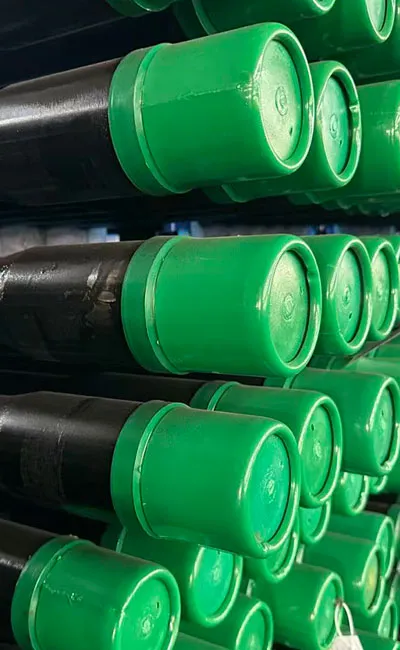
1. End Protection: The pipe ends (typically 100mm to 150mm) are left uncoated to facilitate welding. These bare steel ends are highly susceptible to rust. We protect them with rust-inhibitive varnish and cover them with plastic caps or waterproof tape to keep them clean and dry.
2. Bundling: Pipes are bundled in hexagonal or square formations using high-tensile steel straps. To prevent the straps from damaging the FBE coating, wooden dunnage or rubber pads are placed between the straps and the pipe surface.
3. UV Protection: While FBE has good UV resistance, prolonged exposure to sunlight can cause "chalking" (surface degradation). For long-term outdoor storage, bundles are often covered with UV-resistant tarpaulins or black polyethylene sheeting.
4. Separation: When stacking bundles, timber sleepers are placed between layers to prevent point-loading and friction damage between the pipes.
5. Marking: Each pipe is clearly marked with stencils indicating the coating standard, thickness, heat number, and manufacturer logo, ensuring traceability at the construction site.
A: The conventional operating temperature for FBE steel pipes is -30°C to 80°C for continuous service. General-purpose FBE has an upper heat resistance limit of 80°C. Short-term exposure up to 120°C (duration≤1 hour) is permissible for temporary conditions such as hydrostatic testing. High-temperature resistant FBE (modified grade with heat-resistant resins) can increase the long-term operating temperature to 100–120°C. Below -30°C, the FBE coating becomes brittle and its impact resistance decreases.
A: Single-layer FBE provides standard anti-corrosion protection for buried pipelines, with typical thickness of 400–500 µm. Dual-layer FBE adds a second epoxy layer or an abrasion-resistant overlay (ARO) applied wet-on-wet, providing enhanced mechanical protection and impact resistance for severe conditions such as offshore projects, HDD installations, or rocky terrain. Total thickness for dual-layer systems is typically 600–1000 µm.
A: Yes, FBE coated pipes are widely used in offshore oil and gas pipelines. FBE coatings offer excellent resistance to cathodic disbondment, making them highly suitable for offshore environments where pipelines are protected by cathodic protection systems. For offshore projects, FBE is frequently combined with a ballast coat of cement mortar, with a rough-coated second FBE layer providing increased shearing resistance.
A: FBE coated pipes have a proven service life of 20–50 years, depending on environmental conditions, operating temperature, and proper maintenance. FBE coatings provide long-term protection against corrosion, significantly reducing lifecycle costs compared to uncoated or poorly protected steel pipes.
The FBE Steel Pipe is manufactured to precise dimensional, coating, and mechanical specifications. Below are the detailed specification tables.
|
Parameter |
Range |
Tolerance / Notes |
|
Outside Diameter (OD) |
21.3 mm – 3000 mm (½″ – 118″) |
Custom diameters available |
|
Wall Thickness (WT) |
2.0 mm – 50 mm |
±10% of nominal |
|
Length |
6 m / 12 m / 12.5 m / 18 m |
Exact cut lengths available (0.5–18 m) |
|
Pipe Types |
LSAW, SSAW, ERW, Seamless |
Base material varies by application |
|
Steel Grades (API 5L) |
Gr.B, X42, X46, X52, X56, X60, X65, X70 (PSL1/PSL2) |
NACE MR0175 for sour service available |
|
Steel Grades (ASTM) |
A53 Gr.A/B, A106 Gr.B/C, A333, A335 |
Per ASTM specification |
|
Steel Grades (EN) |
S235, S275, S355, L245, L290, L360, L415 |
Per EN 10217 / EN 10219 |
|
Steel Grades (GB/T 9711) |
L245, L290, L360, L415, L450 |
Chinese national standard |
Testing & Inspection Requirements
• Coating thickness measurement: Using magnetic induction or ultrasonic gauges; minimum four readings per joint distributed radially to ensure circumferential uniformity.
• Holiday/leak detection (spark test): 5–15 kV voltage depending on coating thickness; inspection speed≤0.3 m/s; no leakage points permitted.
• Adhesion test: Cross-cut or pull-off test conducted per heat.
• Cathodic disbondment test: Performed to ASTM G8 or NACE TM0186.
• Impact test: Performed to ASTM G14 at 23°C and -30°C.
• Hydrostatic test: Minimum test pressure 600 psi for NPS≤4″, or 450 psi for larger sizes.
• Hardness testing: Conducted per ASTM D2240 (Shore D).
Compliance with international standards is critical for FBE pipes, as the coating must perform reliably for decades. The most widely referenced standards include CSA Z245.20 (Canadian Standards Association), AWWA C213 (American Water Works Association), and ISO 21809-2. These standards define the material properties, application methods, and quality control testing procedures.
|
Standard |
Scope |
Key Requirement |
|
CSA Z245.20 |
Plant-Applied External Coatings |
Defines performance requirements for FBE, including bendability and cathodic disbondment. |
|
AWWA C213 |
Fusion-Bonded Epoxy Coating |
Specifically for water and wastewater steel pipes. Focuses on non-toxicity and immersion resistance. |
|
ISO 21809-2 |
Single Layer FBE |
International standard for buried or submerged pipelines. Specifies thickness and adhesion tests. |
|
NACE RP0394 |
Application, Inspection, and Repair |
Recommended practice for field application and quality assurance of FBE coatings. |
|
ASTM A775 / A934 |
Epoxy-Coated Steel Reinforcing Bars |
While for rebar, the chemistry is similar; often referenced for material specs. |
The application of Fusion Bonded Epoxy is a precise, factory-controlled process that relies heavily on thermal chemistry.
1. Surface Preparation: The process begins with the steel pipe entering a blast cleaning chamber. Steel grit or shot is blasted onto the pipe surface to remove all rust, mill scale, and contaminants. The goal is to achieve a Sa 2.5 (Near-White Metal) cleanliness level with a specific surface profile (anchor pattern) of 50-100 microns to ensure mechanical interlocking.
2. Induction Heating: The cleaned pipe moves into an induction heating coil. The pipe is heated rapidly to a specific temperature, typically between 200°C and 240°C. This temperature is critical; it must be high enough to melt the epoxy powder instantly upon contact but not so high that it degrades the coating.
3. Electrostatic Spraying: As the hot pipe rotates, electrostatic spray guns apply the FBE powder. The powder particles are electrically charged, which attracts them to the grounded steel pipe, ensuring a uniform wrap-around coverage.
4. Gelation and Curing: Upon contact with the hot steel, the powder melts (gels) and chemically cross-links (cures) to form a thermoset plastic. This reaction creates a chemical bond with the steel surface, which is the hallmark of FBE's superior adhesion.
5. Quenching: The pipe passes through a water quench station to cool it down rapidly, locking in the coating properties and allowing it to be handled immediately.
FBE coatings are tough but can be susceptible to damage from sharp impacts or UV degradation if left exposed for long periods. Therefore, packing protocols are strictly followed.
1. End Protection: The pipe ends (typically 100mm to 150mm) are left uncoated to facilitate welding. These bare steel ends are highly susceptible to rust. We protect them with rust-inhibitive varnish and cover them with plastic caps or waterproof tape to keep them clean and dry.
2. Bundling: Pipes are bundled in hexagonal or square formations using high-tensile steel straps. To prevent the straps from damaging the FBE coating, wooden dunnage or rubber pads are placed between the straps and the pipe surface.
3. UV Protection: While FBE has good UV resistance, prolonged exposure to sunlight can cause "chalking" (surface degradation). For long-term outdoor storage, bundles are often covered with UV-resistant tarpaulins or black polyethylene sheeting.
4. Separation: When stacking bundles, timber sleepers are placed between layers to prevent point-loading and friction damage between the pipes.
5. Marking: Each pipe is clearly marked with stencils indicating the coating standard, thickness, heat number, and manufacturer logo, ensuring traceability at the construction site.
A: The conventional operating temperature for FBE steel pipes is -30°C to 80°C for continuous service. General-purpose FBE has an upper heat resistance limit of 80°C. Short-term exposure up to 120°C (duration≤1 hour) is permissible for temporary conditions such as hydrostatic testing. High-temperature resistant FBE (modified grade with heat-resistant resins) can increase the long-term operating temperature to 100–120°C. Below -30°C, the FBE coating becomes brittle and its impact resistance decreases.
A: Single-layer FBE provides standard anti-corrosion protection for buried pipelines, with typical thickness of 400–500 µm. Dual-layer FBE adds a second epoxy layer or an abrasion-resistant overlay (ARO) applied wet-on-wet, providing enhanced mechanical protection and impact resistance for severe conditions such as offshore projects, HDD installations, or rocky terrain. Total thickness for dual-layer systems is typically 600–1000 µm.
A: Yes, FBE coated pipes are widely used in offshore oil and gas pipelines. FBE coatings offer excellent resistance to cathodic disbondment, making them highly suitable for offshore environments where pipelines are protected by cathodic protection systems. For offshore projects, FBE is frequently combined with a ballast coat of cement mortar, with a rough-coated second FBE layer providing increased shearing resistance.
A: FBE coated pipes have a proven service life of 20–50 years, depending on environmental conditions, operating temperature, and proper maintenance. FBE coatings provide long-term protection against corrosion, significantly reducing lifecycle costs compared to uncoated or poorly protected steel pipes.








 English
 Español
 русский язык
 Português