Characteristics, Production, and Applications of Q355NB Longitudinal Welded Steel Pipe
Date: 2025-09-25
Characteristics, Production, and Applications of Q355NB Longitudinal Welded Steel Pipe
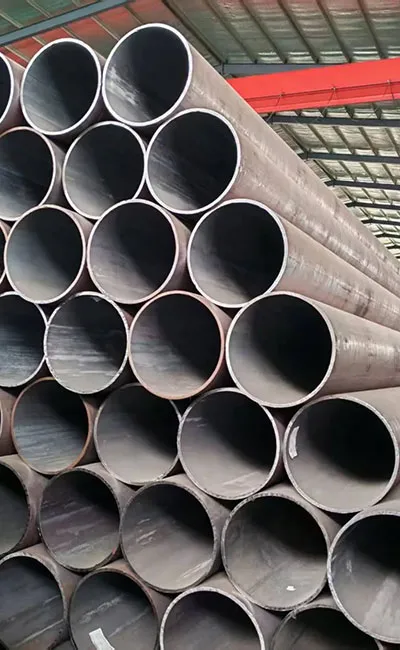
Q355NB longitudinally welded steel pipe is a high-strength welded steel pipe widely used in construction, bridges, machinery manufacturing, and other fields. With the continuous advancement of my country’s infrastructure construction and the need for upgrading industrial manufacturing, Q355NB longitudinally welded steel pipe has become a key material choice in steel structure projects due to its excellent mechanical properties and adaptability to welding processes.
First, Material Characteristics and Standard Specifications of Q355NB Longitudinal Welded Steel Pipe
Q355NB is a low-alloy, high-strength structural steel. Its nomenclature follows the GB/T 1591-2018 standard, where “Q” represents yield strength, “355″ indicates a lower yield strength limit of 355 MPa, “N” indicates delivery in the normalized state, and “B” represents the quality grade (impact temperature 20°C). By adding microalloying elements such as niobium and vanadium to refine the grain size, this material significantly improves low-temperature toughness and brittle fracture resistance, making it suitable for use in extremely cold regions or under dynamic loads. Compared to conventional Q235B steel pipe, Q355NB straight seam welded steel pipe boasts approximately 30% greater strength while maintaining excellent ductility and weldability. Its chemical composition is subject to stringent requirements, with the carbon equivalent (Ceq) typically controlled below 0.42% to prevent cold cracking during welding. Furthermore, according to standards such as GB/T 3091-2015 “Welded Steel Pipe for Low-Pressure Fluid Transportation” and GB/T 13793-2016 “Straight Seam Electric-Welded Steel Pipe,” Q355NB straight seam welded steel pipe must meet industrial-grade requirements for dimensional tolerances, weld quality, and non-destructive testing.
Second, the production process and key technical points of Q355NB straight seam welded steel pipe.
Q355NB straight seam welded steel pipe is primarily produced using high-frequency electric resistance welding (ERW) or submerged arc welding (SAW). The specific process includes:
1. Strip pretreatment: After uncoiling and leveling, the steel coil is milled to ensure the cleanliness of the weld area.
2. Forming welding: The steel is formed into a round tube through multiple roll presses. The edges are heated to a molten state using a high-frequency current, and then pressurized and welded.
3. Weld seam treatment: Internal and external burrs are removed, and online ultrasonic testing (UT) is performed to ensure the weld is free of incomplete fusion or porosity.
4. Sizing and heat treatment: Cold expansion improves dimensional accuracy, and normalizing improves microstructure uniformity.
5. Inspection and corrosion protection: Hydrostatic testing, X-ray testing (RT), and surface treatments such as epoxy coating and galvanizing are performed.
The key technical difficulty lies in controlling welding parameters. For example, the input power of high-frequency welding needs to be dynamically adjusted according to the wall thickness to avoid overheating and grain coarsening. Some high-end production lines have introduced laser tracking systems to monitor weld morphology in real time, achieving a yield rate exceeding 99%.
Third, Application Scenarios and Project Case Studies of Q355NB Straight-Seam Welded Steel Pipe
- Building Steel Structures: Columns for super-high-rise buildings and large-span trusses, such as airport terminal roof support systems;
- Bridge Engineering: Arch ribs and pier structures for cross-river bridges; weather-resistant versions reduce maintenance costs;
- Energy Transportation: Medium- and low-pressure oil and gas pipelines, particularly suitable for use in high-altitude and cold regions;
- Machinery Manufacturing: Construction machinery booms and load-bearing components for port cranes, replacing traditional forging with a 20% cost reduction.
For example, in a wind turbine tower project, Q355NB straight-seam welded steel pipe (size 2000 × 30 mm) was used instead of traditional flange connections, reducing overall weight by 15%. The pipe also passed the -30°C impact test, meeting the requirements of polar wind farms.
Fourth, the current market situation and development trends of Q355NB straight seam welded steel pipes.
By 2024, my country’s straight seam welded steel pipe market will exceed 80 billion yuan, with high-strength steels such as Q355NB accounting for 35%. Companies are introducing JCOE forming equipment to achieve domestic production of thick-walled steel pipes with a wall thickness of 40 mm or more, breaking their reliance on imports.
Future trends suggest three key directions:
1. Green manufacturing: Promoting hydrogen reduction steelmaking processes to reduce the carbon emissions intensity of Q355NB;
2. Intelligent upgrades: Flexible production lines based on digital twins enable rapid switching between different steel grades.
3. Composite applications: Composites with glass fiber reinforced plastic (GFRP) create lightweight products, expanding into emerging areas such as new energy vehicle battery frames.
Notably, growing international demand for ASTM A572 Gr50 (the American Standard equivalent) is driving domestic companies to accelerate certification efforts. Exports of Q355NB straight seam welded steel pipes to Southeast Asia have increased by 40% year-on-year, primarily for photovoltaic mounting systems.
Fifth, Q355NB Longitudinal Welded Steel Pipe Selection and Quality Control Recommendations
1. Qualification Documents: The steel mill’s quality assurance document must include measured mechanical property data and a third-party inspection report;
2. Process Verification: Suppliers are required to provide welding process qualification records.
3. On-site Inspection: Use a portable hardness tester to spot-check the weld area to ensure hardness ≤ 250HV10;
4. Corrosion Protection: For coastal projects, hot-dip galvanizing (zinc layer ≥ 80μm) or spray alloy coating is preferred.
For special operating conditions (such as acidic environments), corrosion-resistant elements such as Cu and Cr may be added, and hydrogen sulfide stress corrosion testing must be conducted in accordance with NACE MR0175.
Conclusion
As a representative of modern engineering materials, Q355NB longitudinally welded steel pipe will continue to improve in terms of technical maturity and market penetration. With the advancement of the “dual carbon” goals, its high strength, lightweight, and long life characteristics will be further highlighted. It is recommended that upstream and downstream of the industrial chain collaborate in innovation, make breakthroughs in material design, intelligent operation and maintenance, and other aspects, to help my country move from a “pipe-making power” to a “pipe-making powerhouse.”
Post time: Sep-25-2025










 English
 Español
 русский язык
 Português