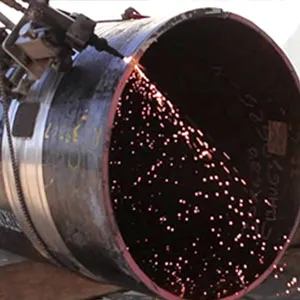
Inspection methods for large diameter straight seam welded steel pipes
Date: 2024-05-08
Inspection methods for large diameter straight seam welded steel pipes
There are many methods for quality inspection of large-diameter straight seam welded steel pipes, among which physical methods are also commonly used. Physical inspection is a method that uses some physical phenomena to measure or inspect. The inspection of internal defects in materials or large-diameter straight seam welded steel pipes generally uses non-destructive testing methods. Current non-destructive testing includes magnetic testing, ultrasonic testing, radiographic testing, penetrant testing, etc.
Magnetic inspection
Magnetic flaw detection can only detect surface and near-surface defects of magnetic large-diameter straight seam welded steel pipes, and can only quantitatively analyze the defects. The nature and depth of the defects can only be estimated based on experience. Magnetic inspection uses the magnetic flux leakage generated by the magnetic field to magnetize ferromagnetic large-diameter straight seam welded steel pipes to find defects. Different methods of measuring magnetic flux leakage can be divided into the magnetic particle method, magnetic induction method, and magnetic recording method. Among them, the magnetic particle method is widely used.
Penetration inspection
Penetrant inspection uses physical properties such as the permeability of certain liquids to discover and display defects, including coloring inspection and fluorescence inspection, which can be used to inspect defects on the surface of ferromagnetic and non-ferromagnetic materials.
Radiographic inspection
Radiographic flaw detection is a flaw detection method that uses the characteristics of rays to penetrate materials and attenuate materials to find defects. According to the different rays used for flaw detection, it can be divided into three types: X-ray flaw detection, gamma-ray flaw detection, and high-energy ray flaw detection. Due to different methods of displaying defects, each type of radiographic flaw detection is divided into the ionization method, fluorescent screen observation method, photography method, and industrial television method. Radiographic inspection is mainly used to inspect defects such as cracks, incomplete penetration, pores, slag inclusions, and other defects inside the weld of large-diameter straight seam welded steel pipes.
Ultrasonic flaw detection
When ultrasonic waves propagate in metals and other uniform media, they will be reflected at the interfaces of different media, so they can be used to inspect internal defects. Ultrasound can detect defects in any weldment material and any part, and can more sensitively find the location of defects, but it is difficult to determine the nature, shape, and size of defects. Therefore, ultrasonic flaw detection of large-diameter straight seam welded steel pipes is often used in conjunction with radiographic inspection.
Post time: May-08-2024










 English
 Español
 русский язык
 Português