What preparations need to be made before industrial welding of steel pipes
Date: 2024-06-06
What preparations need to be made before industrial welding of steel pipes
Galvanized steel pipes are a commonly used material in modern life, and welding is the most commonly used connection method. The quality of welding is directly related to the safety and stability of the product. So what problems should we pay attention to to ensure the quality of welded products?
1. Steel pipe thickness In the production and use of welded steel pipes, the thickness of the steel pipe is a very important parameter. However, due to production and processing reasons, the thickness of the steel pipe may have a certain deviation. These standards specify parameters such as size, thickness, weight, and tolerance of welded steel pipes to ensure the quality and safety of steel pipes. The deviation of the thickness of welded steel pipes may affect the quality and safety of steel pipes. If the thickness deviation of the steel pipe is too large, it may cause the bearing capacity of the steel pipe to decrease, thereby affecting the safety and stability of the product. To control the deviation of the thickness of welded steel pipes, international standards usually stipulate the standards for the allowable deviation of the thickness of welded steel pipes. In actual production and use, it is necessary to strictly control and manage according to the standards to ensure the quality and safety of steel pipes.
We strictly control the thickness of steel pipes. For steel pipes of the same specification, the thickness tolerance is ±5%. We strictly control the quality of each steel pipe. We conduct thickness testing on each batch of steel pipes to prevent unqualified products from entering the market, safeguard the rights and interests of consumers, and ensure the safety and reliability of each steel pipe.
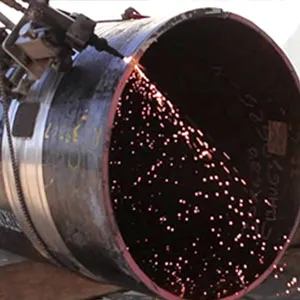
2. During the welding process of steel pipes, another important thing is the treatment of the pipe mouth of the steel pipe. Whether it is suitable for welding greatly affects the quality of the finished product after welding. First of all, it is necessary to keep the pipe mouth free of floating rust, dirt, and grease. These wastes greatly affect the welding quality, which will cause the weld to be uneven and broken during welding, and even affect the entire welding product. The flatness of the cross-section is also an important matter that must be done before welding. If the cross-section is too tilted, it will cause the steel pipe to bend and appear at an angle, affecting the use. When welding, the burrs, and attachments at the fracture of the steel pipe must also be checked, otherwise it will not be welded. The burrs on the steel pipe will also scratch the workers and damage their clothes when they are processing, which greatly affects safety.
Considering the welding problems of users, we added a pipe mouth processing process in process to ensure that the pipe mouth interface is smooth, flat, and burr-free. When using steel pipe welding, there is no need to re-cut the pipe mouth, which is convenient for users to weld in daily use. The implementation of this process can not only reduce the waste of scraps that we had to see in welding before, but also increase production efficiency, reduce welding deformation, and further improve the welding quality of products.
3. Weld The weld of steel pipe refers to the weld formed by the steel pipe during the welding process. The quality of the steel pipe weld directly affects the performance and safety of the steel pipe. If there are defects in the steel pipe weld, such as pores, slag inclusions, cracks, etc., it will affect the strength and sealing of the steel pipe, resulting in leakage and fracture of the steel pipe during the welding process, thereby affecting the quality and safety of the product.
To ensure the quality of welds, we have added turbine weld detection equipment to the production line to detect the weld status of each steel pipe. If there is a weld problem during the production process, an alarm will be immediately sounded to prevent problematic products from being put into the finished product package. We conduct non-destructive testing, metallographic analysis, mechanical property testing, etc. on each batch of steel pipes leaving the factory to ensure that downstream customers do not encounter problems such as unstable product performance and slow welding progress due to steel pipe problems during processing operations.
Post time: Jun-06-2024










 English
 Español
 русский язык
 Português