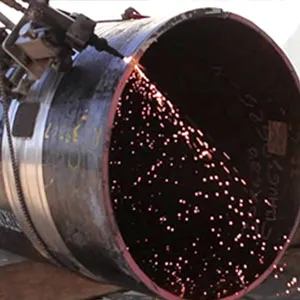
Carbon steel tube flaw detection method
Date: 2023-09-04
Carbon steel tube flaw detection method
Commonly used non-destructive testing methods for carbon steel tubes are: ultrasonic testing (UT), magnetic particle testing (MT), liquid penetrant testing (PT) and X-ray testing (RT).
The applicability and limitations of ultrasonic testing are:
It mainly uses the strong penetrability and good directionality of ultrasonic waves to collect the reflection of ultrasonic waves in different media, and convert the interference waves into electronic digital signals on the screen to realize non-destructive flaw detection. Advantages: no damage, no impact on the performance of the inspected object, accurate imaging of the internal structure of opaque materials, a wide range of detection applications, suitable for metals, non-metals, composite materials and other materials; more accurate defect positioning; sensitive to area defects, High sensitivity, low cost, fast speed, harmless to human body and environment.
Limitations: Ultrasonic waves must rely on media and cannot propagate in a vacuum. Ultrasonic waves are easily lost and scattered in the air. Generally, detection requires the use of couplants that connect the detection objects, and media such as (deionized water) are common.
The applicability and limitations of magnetic particle testing are:
1. Magnetic particle inspection is suitable for detecting discontinuities that are small in size on the surface and near the surface of ferromagnetic materials, and the gap is extremely narrow and difficult to see visually.
2. Magnetic particle inspection can detect parts in various situations, and can also detect various types of parts.
3. Defects such as cracks, inclusions, hairlines, white spots, folds, cold shuts and looseness can be found.
4. Magnetic particle testing cannot detect austenitic stainless steel materials and welds welded with austenitic stainless steel electrodes, nor can it detect non-magnetic materials such as copper, aluminum, magnesium and titanium. It is difficult to find delaminations and folds with shallow scratches on the surface, buried deep holes, and angles less than 20° with the workpiece surface.
The advantages of penetrant detection are: 1. It can detect various materials; 2. It has high sensitivity; 3. It has intuitive display, convenient operation and low detection cost.
The shortcomings of penetrant testing are: 1. It is not suitable for inspecting workpieces made of porous loose materials and workpieces with rough surfaces; 2. Penetrant testing can only detect the surface distribution of defects, and it is difficult to determine the actual depth of defects, so it is difficult to detect Quantitative evaluation of defects. The detection result is also greatly influenced by the operator.
Applicability and limitations of radiographic testing:
1. It is more sensitive to the detection of volume-type defects, and it is easier to characterize the defects.
2. Radiographic negatives are easy to keep and have traceability.
3. Visually display the shape and type of defects.
4. Disadvantages The burial depth of the defect cannot be located. At the same time, the detection thickness is limited. The negative film needs to be washed specially, and it is harmful to the human body, and the cost is high.
Post time: Sep-04-2023










 English
 Español
 русский язык
 Português