Common Piping and Plumbing Fittings
Date: 2019-09-23
Common Piping and Plumbing Fittings
Common Piping and Plumbing Fittings-Elbow
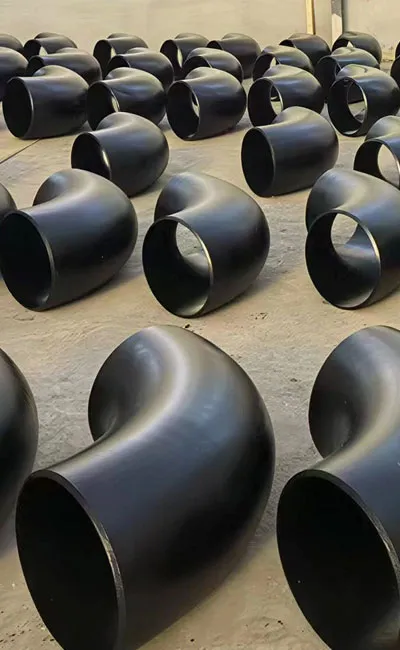
An elbow is installed between two lengths of pipe (or tubing) to allow a change of direction, usually a 90° or 45° angle; 22.5° elbows are also available. The ends may be machined for butt welding, threaded (usually female) or socketed. When the ends differ in size, it is known as a reducing (or reducer) elbow.
Elbows are categorized by design. The radius of a long-radius (LR) elbow is 1.5 times the pipe diameter. In a short-radius (SR) elbow, the radius equals the pipe diameter. Ninety-, 60- and 45-degree elbows are also available.
A 90-degree elbow, also known as a “90 bend”, “90 ell” or “quarter bend”, attaches readily to plastic, copper, cast iron, steel and lead and attaches to rubber with stainless-steel clamps. Available materials include silicone, rubber compounds, galvanized steel and nylon. It is primarily used to connect hoses to valves, water pumps and deck drains. A 45-degree elbow, also known as a “45 bend” or “45 ell”, is commonly used in water-supply facilities, food, chemical and electronic industrial pipeline networks, air-conditioning pipelines, agriculture and garden production and solar-energy facility piping.
Most elbows are available in short- or long-radius versions. Short-radius elbows have a center-to-end distance equal to the Nominal Pipe Size (NPS) in inches, and long-radius elbows are 1.5 times the NPS in inches. Short elbows, widely available, are typically used in pressurized systems.
Long elbows are used in low-pressure gravity-fed systems and other applications where low turbulence and minimum deposition of entrained solids are of concern. They are available in acrylonitrile butadiene styrene (ABS plastic), polyvinyl chloride (PVC), chlorinated polyvinyl chloride (CPVC) and copper for DWV systems, sewage and central vacuums.
Common Piping and Plumbing Fittings-Tee
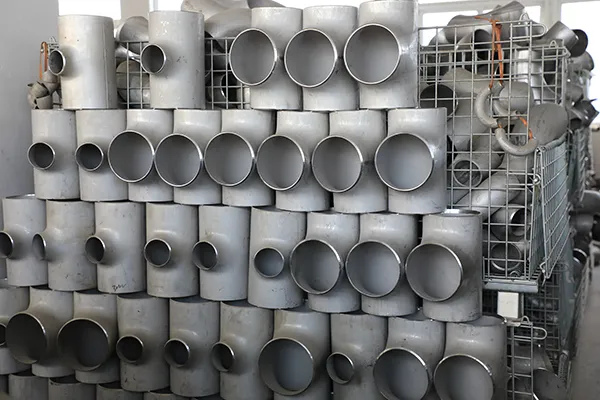
A tee, the most common pipe fitting, is used to combine (or divide) fluid flow. It is available with female thread sockets, solvent-weld sockets or opposed solvent-weld sockets and a female-threaded side outlet. Tees can connect pipes of different diameters or change the direction of a pipe run. Available in a variety of materials, sizes and finishes, they are used to transport two-fluid mixtures. Tees may be equal or unequal in size, with equal tees the most common.
Common Piping and Plumbing Fittings-Union
A union, similar to a coupling, allows the convenient disconnection of pipes for maintenance or fixture replacement. Although a coupling requires solvent welding, soldering or rotation (threaded couplings), a union allows easy connection and disconnection. It consists of three parts: a nut, a female end and a male end. When the female and male ends are joined, the nut seals the joint. Unions are a type of flange connector.
Dielectric unions, with dielectric insulation, separate dissimilar metals (such as copper and galvanized steel) to prevent galvanic corrosion. When two dissimilar metals are in contact with an electrically-conductive solution (tap water is conductive), they form a battery generating a voltage by electrolysis. When the metals are in direct contact with each other, the electric current from one to the other moves ions from one to the other; this dissolves one metal, depositing it on the other. A dielectric union breaks the electrical path with a plastic liner between its halves, limiting galvanic corrosion. Rotary unions allow rotation of one of the joined parts.
Post time: Sep-23-2019










 English
 Español
 русский язык
 Português