Details Regarding Low-Alloy Q890E Seamless Steel Pipes Commonly Used in Engineering Machinery Projects
Date: 2025-12-20
Details Regarding Low-Alloy Q890E Seamless Steel Pipes Commonly Used in Engineering Machinery Projects
First, Material Characteristics of Q890E Seamless Steel Pipes.
Q890E belongs to quenched and tempered high-strength steel, possessing the following outstanding characteristics:
1. High Strength Performance: Yield strength ≥ 890MPa, tensile strength up to 930-1150MPa
2. Excellent Low-Temperature Toughness: Impact Energy at -40℃ ≥ 27J (E-grade steel requirement)
3. Good Weldability: Carbon Equivalent (CEV) ≤ 0.50%, Weld Cold Cracking Sensitivity Coefficient (Pcm) ≤ 0.25%
4. High Dimensional Accuracy: Outer Diameter Tolerance ±0.5%, Wall Thickness Tolerance ±10%
Second, Production Process of Q890E Seamless Steel Pipes.
1. Smelting Process: Smelting in a converter or electric furnace, LF ladle refining, VD/VOD vacuum degassing treatment, and strict control of P and S content (≤ 0.015%).
2. Hot rolling process: Continuously cast round billets are heated to 1200-1250℃, hot piercing is performed using a piercing mill, rolling is done on a limited-movement mandrel continuous rolling mill, and precise dimensional control is achieved using a sizing mill.
3. Heat treatment process: Quenching temperature 880-920℃, tempering temperature 550-650℃, online residual heat quenching technology is used to improve efficiency.
Third, the main application areas of Q890E seamless steel pipes.
1. Construction machinery: Crane booms, pump truck booms, excavator booms, and loader front and rear frames.
2. Energy equipment: Coal mine hydraulic supports, oil drill pipes, wind power tower connectors.
3. Special vehicles: Military armored vehicle chassis, fire ladder truck booms, special transport vehicle structural components.
Application trends: The demand for lightweight construction machinery drives increased usage; offshore wind power construction brings new application scenarios; and the upgrading of special vehicle protection promotes material upgrades.
Fourth, quality inspection standards for Q890E seamless steel pipes.
1. Chemical Composition Analysis: Alloy elements are detected by a spectrometer; C and S content is determined by an infrared carbon-sulfur analyzer.
2. Mechanical Property Testing: Tensile strength is tested by a universal testing machine; toughness is tested by a low-temperature impact testing machine; Brinell hardness is tested by a hardness tester.
3. Non-destructive Testing: Internal defects are inspected by ultrasonic testing; surface cracks are detected by eddy current testing; pressure resistance is verified by hydrostatic testing.
Fifth, Current Market Development Status of Q890E Seamless Steel Pipe
Technological Progress.
Higher-grade Q960 and Q1100 steel grades have been developed; mass production of specifications with a maximum diameter of Φ426mm and a wall thickness of 50mm has been achieved; and a temper-free Q890E steel has been successfully developed.
Sixth, Precautions for Using Q890E Seamless Steel Pipe.
1. Processing Recommendations:
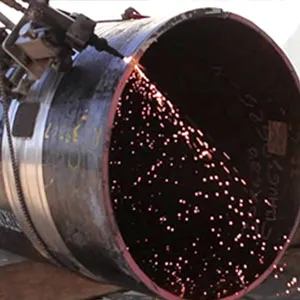
- Use plasma cutting or laser cutting.
- Use carbide drill bits when drilling.
- Control the minimum bending radius when cold bending.
2. Welding Process:
- Recommended heat input of less than 80kJ/cm.
- Preheat to 150-200℃ before welding. Post-weld hydrogen removal treatment at 250℃ for 2 hours
3. Corrosion protection measures:
- Sandblasting to Sa2.5 grade
- Epoxy zinc-rich primer + polyurethane topcoat
- Hot-dip galvanizing can be used for important components
Seventh, Future development direction of Q890E seamless steel pipe.
1. Material research and development: Develop higher strength Q1100E steel, improve low-temperature impact toughness at -60℃, and reduce alloy costs
2. Process innovation: Explore direct rolling technology, develop online quenching + tempering integrated process, and apply intelligent controlled rolling and cooling technology
3. Application expansion: Deep-sea oil and gas extraction equipment, polar engineering machinery, aerospace launch support equipment
Post time: Dec-22-2025










 English
 Español
 русский язык
 Português