Price List

Hunan Great Steel Pipe Co., Ltd
spiral submerged arc pipe,A213 alloy steel pipe,dsaw steel pipe

Difference between Submerged Arc Welding and High Frequency Welding

Date: 2023-08-02
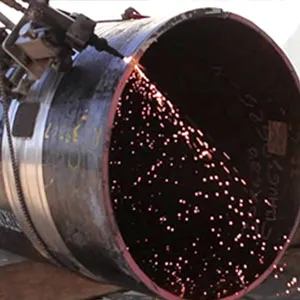
Difference between Submerged Arc Welding and High Frequency Welding Submerged arc welding is an arc welding under flux layer combustion method. Welding arc between the wire and the weldment burning heat of the arc and arc welding wire ends near the base metal and solder melts, continue feeding the wire, and proceeds along a certain trajectory, an arc weld pool solidified metal is removed to weld the molten solder is solidified into a shell covering the surface of the weld slag, slag of molten pool and weld metal for protection against arcing and the pool by the outside air intrusion. Submerged arc welding arc, wire, wire and shift interrupter such action is usually done by machine, it is known as submerged arc welding. SAW has the following advantages: ① high degree of mechanization, for welders require low skill levels; ② welding current, can be reduced weldments groove, high welding efficiency; ③ can be separated from molten solder metal contact with the air, the protective effect good, high weld quality; ④ covered with arc radiation, better working conditions. The disadvantage is that only in the flat position welding, welding equipment and tooling equipment demanding. High-frequency welding to high frequency current heating of the workpiece, and then applying pressure welding joints (see figure) is formed. A high-frequency current is concentrated along the surface of a conductor and flow along the path of least inductance over principle, the current will be concentrated heating of the workpiece surface to be welded, the thermoplastic state is reached, or partially molten state, extruding the molten metal on the workpiece and pressing the metal oxide, is formed of welded joints. High-frequency welding common frequency range of 60 to 500 kHz. High frequency resistance welding high frequency welding points and two high-frequency induction welding. ① High Frequency Resistance Welding: the contact with the wheel or as a sub-electrode high-frequency currents in the workpiece, suitable for continuous longitudinal seam welded pipe and spiral lap seam welding, boiler tube and fin heat exchanger spiral welded fin, external diameter pipe can be 1200 mm and a wall thickness of 16 mm, ventral beam welding electrode thickness 9.5 mm, high productivity. ② high-frequency induction welding: a small diameter tube and the wall thickness of the workpiece by the induction heating coil can be welded to an outer diameter of 9 mm and 1 mm thin-walled tube. Commonly used in small diameter longitudinal pipe seam welding and brass can also be used girth weld, but power consumption is greater than the high-frequency resistance welding. The main parameters affecting the high-frequency welding quality is high-frequency power frequency, power, workpiece forming angle, welding speed and pressure from the squeeze, the electrode (or induction coil) and squeeze rollers. Major equipment frequency power supply, the workpiece forming apparatus and extrusion machinery. Stable high-frequency welding quality, high productivity and low cost. For high-efficiency automatic production line, the production of advanced methods slit tube. Post time: Aug-02-2023

Latest news list

  • stainless seamless steel pipe,high temperature stainless steel pipe,stainless steel pipe selection
    High-temperature piping requires more than simply selecting a stainless steel grade,As temperature increases,material strength,corrosion behavior,thermal expansion,pressure resistance,and long-term stability become increasingly important,For this reason,stainless seamless steel pipe should be selected against the complete service condition rather than temperature alone,
  • stainless seamless steel pipe,stainless seamless steel pipe manufacturing,stainless steel pipe quality control
    Stainless seamless steel pipe is used in chemical processing,oil and gas,power generation,water treatment,food processing,and other applications where material performance and pressure integrity matter,But a finished pipe does not become reliable simply because it is made from stainless steel,Its quality is built through material control,forming,heat treatment,dimensional control,inspection,and traceability,Understanding how stainless seamless steel pipe is manufactured gives engineers and technical buyers a better way to evaluate suppliers beyond price,surface appearance,or a product catalogue,
  • LSAW steel pipe maintenance,LSAW pipe maintenance,LSAW steel pipe inspection,LSAW pipeline maintenance
    Installing a properly specified LSAW steel pipe does not eliminate the need for pipeline maintenance,Once a pipeline enters service,corrosion,coating deterioration,mechanical loading,ground movement,operating changes,and environmental exposure can gradually affect its condition,For large-diameter pipelines,a practical maintenance program should focus on identifying changes early and taking corrective action before a manageable condition develops into an integrity problem,The objective is not simply to inspect the pipe,It is to understand the condition of the complete pipeline system and respond based on evidence,
  • LSAW steel pipe,LSAW steel pipe for high pressure,high-pressure pipeline,LSAW pipe wall thickness
    High-pressure pipeline systems place demanding requirements on pipe material,dimensions,weld integrity,inspection,and operating conditions,For large-diameter pipelines,LSAW steel pipe can be an effective solution because its manufacturing process allows large outside diameters and substantial wall thicknesses to be produced from steel plate,However,selecting LSAW steel pipe for pressure service is not simply a matter of choosing a thicker wall,The pipe specification needs to match the actual design pressure,temperature,fluid,diameter,applicable code,and service environment,
  • LSAW steel pipe corrosion,LSAW steel pipe coating,3PE coated LSAW steel pipe,FBE coated steel pipe
    LSAW steel pipe is widely used for large-diameter water transmission,buried pipelines,and other infrastructure projects where strength,dimensional control,and long-term service reliability are important,However,pipe strength alone does not prevent corrosion,For buried or water pipeline systems,corrosion protection should be considered from material selection and coating through transportation,field welding,installation,and long-term inspection,A coating system should also be selected according to the actual operating environment rather than simply by initial cost,

Find what you need ?

close
We use cookies and other tracking technologies to improve your browsing experience on our website, to show you personalized content and targeted ads, to analyze our website traffic, and to understand where our visitors are coming from.