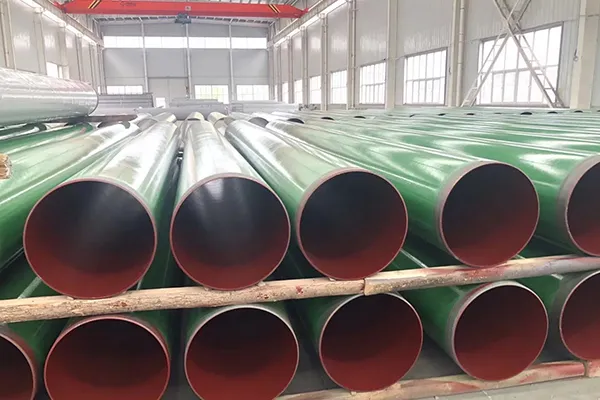
4. Coating Curing and Cooling
Following application, the epoxy coating continues to cure under controlled thermal conditions. The required temperature and curing conditions depend on the powder formulation and qualified application procedure. Once the coating has developed the required properties, the pipe is cooled under controlled conditions. Proper handling during this stage helps prevent impact damage, scratches and other defects.
5. FBE Coating Inspection and Repair
After cooling, the finished coating undergoes inspection according to the project requirements. Typical checks include visual inspection, coating thickness measurement and holiday detection to identify discontinuities in the protective film. Adhesion and other performance tests may also be required under the applicable coating specification and inspection plan. Any permitted coating defects must be repaired using an approved repair procedure. Repaired areas should be reinspected as required. Inspection records and repair details should remain traceable to the individual pipe or production batch.
What Determines FBE Coating Quality?
Several production factors work together to determine the final coating quality:
-
Surface condition: Cleanliness, surface profile and freedom from contamination affect coating adhesion.
-
Coating material: Epoxy powder must be qualified and suitable for the specified service conditions.
-
Application temperature: Incorrect heating can affect powder flow, film formation and curing.
-
Coating thickness: The finished film must meet the specified minimum and maximum thickness.
-
Inspection and repair: Holiday detection, visual checks and other specified tests help identify defects before delivery.
For external single-layer FBE coatings on buried or submerged oil and gas pipelines, ISO 21809-2:2026 provides requirements covering material qualification, application, inspection and testing. The applicable standard and acceptance criteria should be confirmed against the actual project scope.
What Should Buyers Check Before Ordering FBE Coated Steel Pipes?
Buyers should confirm more than the coating type. The purchase specification should identify the base pipe standard and grade, outside diameter, wall thickness, coating class, thickness requirements, pipe-end cutback, inspection scope and documentation requirements. It is also important to agree on the inspection and testing plan before production. This helps ensure that the coating applicator, supplier and purchaser work to the same technical requirements. At
Hunan Great Steel Pipe Co., Ltd. (HNSSD), we coordinate steel pipe sourcing, external coating arrangements, inspection requirements and export documentation according to confirmed project specifications. Our focus is to keep product requirements and delivery arrangements aligned throughout the supply process.
FAQ
Q1. Is FBE steel pipe a type of steel material?
A1: No. FBE refers to the fusion-bonded epoxy coating applied to a steel pipe. The base pipe can be manufactured from different steel grades according to the project requirements.
Q2. Why is surface preparation important for FBE coating?
A2: Surface preparation removes contaminants and creates the required surface profile for coating adhesion. Poor preparation can lead to adhesion problems and premature coating failure.
Q3. Are FBE coatings applied to both the inside and outside of steel pipes?
A3: Not necessarily. FBE may be specified for external coating, internal coating or both. The coating scope should be clearly stated in the purchase specification.
Q4. How is the quality of FBE coated steel pipe inspected?
A4: Typical inspection includes visual examination, coating thickness measurement and holiday detection. Adhesion and other performance tests are carried out when required by the applicable specification.
Q5. Which standard applies to FBE coated pipeline steel pipes?
A5: ISO 21809-2:2026 covers plant-applied, external single-layer FBE coatings for buried or submerged steel pipelines used in oil and gas pipeline transportation systems. Other applications may require different standards or project-specific requirements.










 English
 Español
 русский язык
 Português