Commonly Used Quality Inspection Methods for Spiral Steel Pipes in Industry
Date: 2025-12-01
Commonly Used Quality Inspection Methods for Spiral Steel Pipes in Industry
1. Surface Judgment (Visual Inspection): Visual inspection of welded joints is a simple procedure with various methods, and is an important part of finished product inspection. It mainly focuses on finding surface defects and dimensional deviations in the weld. Generally, it is done by visual observation, using standard gauges, magnifying glasses, and other tools. If defects are present on the weld surface, there may be defects within the weld itself.
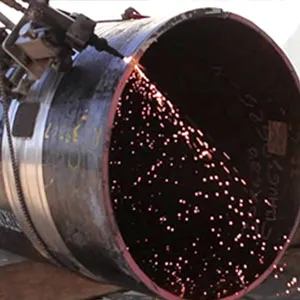
2. Physical Inspection Methods: Physical inspection methods utilize certain physical phenomena for inspection. For inspecting internal defects in materials or parts, non-destructive testing methods are generally used. X-ray flaw detection is one of the most commonly used non-destructive testing methods for spiral steel pipes. This method is characterized by its objectivity and directness; the X-ray machine provides real-time imaging, and software automatically identifies, locates, and measures defects.
3. Strength Testing of Pressure Vessels: In addition to sealing tests, pressure vessels also undergo strength tests. These typically include hydraulic and pneumatic tests. They can test the weld density of containers and spiral steel pipes operating under pressure. Pneumatic testing is more sensitive and faster than hydraulic testing, and the tested product does not require drainage, especially for products that are difficult to drain. However, the risks of this test are higher than those of the hydraulic test. Appropriate safety and technical measures must be followed during the test to prevent accidents.
4. Compaction Test: For welded containers storing liquids or gases, where the welds are free of defects such as penetrating cracks, porosity, slag, impermeability, and loose structure, a compaction test can be used to determine compaction. Compaction test methods include kerosene testing, water testing, etc.
5. Hydrostatic Pressure Test: Each spiral steel pipe should undergo a hydrostatic pressure test without leakage. The test pressure is calculated as P = 2ST / D, where S is the hydrostatic pressure in MPa. The hydrostatic pressure is 60% of the output specified in the relevant standard. Settling time: For D < 508, the test pressure should be maintained for at least 5 seconds; for D≥ 508, the test pressure should be maintained for at least 10 seconds.
6. Non-destructive testing of structural steel pipe welds, steel head welds, and circumferential joints should be performed using X-ray or ultrasonic testing. For spiral welds in steel pipes used for transporting flammable common fluids, 100% X-ray or ultrasonic testing should be performed. Spiral welds in steel pipes transporting general fluids such as water, sewage, air, and heating steam should also be inspected using X-ray or ultrasonic testing. The advantages of X-ray inspection are objective imaging, low requirements for specialized knowledge, and data storage and traceability.
Post time: Dec-01-2025










 English
 Español
 русский язык
 Português