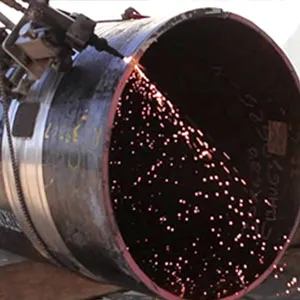
What are the methods for testing the wall thickness of thin-walled stainless steel pipes
Date: 2026-01-13
What are the methods for testing the wall thickness of thin-walled stainless steel pipes
Currently, the labeled thickness of many thin-walled stainless steel pipes on the market differs from their actual thickness, especially since the labeled thickness varies from manufacturer to manufacturer. This leads to confusion for many consumers regarding the actual thickness of the steel pipes. Differences in manufacturer, material, batch, and furnace number can all cause deviations in pipe wall thickness. Therefore, we cannot rely solely on the thickness of the label; we should measure the actual thickness according to our specific needs.
1. A wall thickness measuring instrument measures thickness based on the principle of ultrasonic pulse reflection. When the ultrasonic pulse emitted by the probe passes through the object being measured and reaches the material interface, the pulse is reflected to the probe. By accurately measuring the propagation time of the ultrasonic wave in the material, the thickness of the material being measured is determined.
2. A wall thickness micrometer works on the principle of a screw pair. It is a measuring instrument for measuring the wall thickness of thin-walled stainless steel pipes by reading the distance between the spherical measuring surface and the flat measuring surface on an arc-shaped ruler frame. Micrometers are generally quite accurate when measuring the thickness of raw materials and are used in raw material inspection.
3. Vernier calipers can also measure the thickness of thin-walled stainless steel pipes, but we use them more often when measuring the pipe diameter.
Furthermore, because thin-walled stainless steel pipes may not be perfectly flat or have internal pits due to untreated surfaces, accurate data requires measurements at multiple points. Measurements taken at the pipe opening may be inaccurate, as burrs on the pipe may indicate a slightly thicker pipe. It is recommended to remove burrs first and then measure on a flat surface.
While using tools is certainly accurate and convenient, the simplest and most direct method is to have the actual thickness stamped on the thin-walled stainless steel pipe itself. Stamping the pipe’s specifications, manufacturing year, and the responsible person’s information onto the steel stamp ensures that users can purchase and use the pipe with confidence, demonstrating honesty and integrity.
The above are methods for measuring the thickness of thin-walled stainless steel pipes. Methods for measuring the thickness of steel pipes include wall thickness gauges, micrometers, and vernier calipers. Secondly, you can visually inspect the steel pipe’s label. The thickness is indicated by both the actual thickness and the labeled thickness, but there is a difference between the two. It is recommended to purchase according to the actual thickness. This way, you can deduce the actual thickness of the thin-walled stainless steel pipe from the actual weight. If the required product thickness has special requirements, it generally needs to be custom-made.
Post time: Jan-13-2026










 English
 Español
 русский язык
 Português