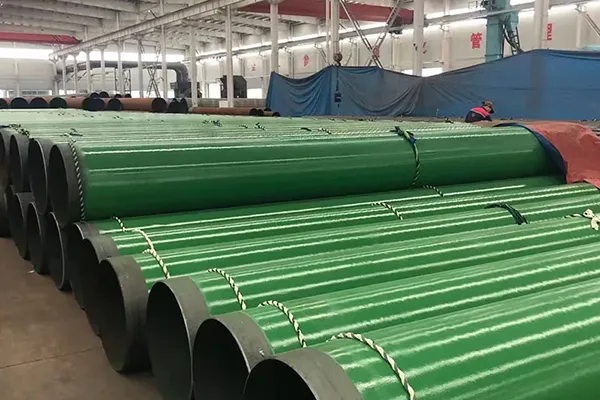
Epoxy-coated steel pipe combines the mechanical properties of a steel pipe with a protective coating designed to resist corrosion and protect the steel pipe surface. It is used in water transmission, industrial fluid systems, fire protection networks, and other applications where corrosion protection is required. The manufacturing process involves more than applying epoxy to a steel surface. The final coating quality depends on the base steel pipe, surface preparation, coating material, application conditions, curing, and inspection. Each stage must follow the requirements of the selected coating system and project specification.
1. Selecting and Preparing the Steel Pipe
Production begins with the selection of a suitable base steel pipe. Depending on the project, this may be a seamless or welded steel pipe manufactured to the specified material grade, dimensions and applicable product standard. Before coating, the steel pipe is checked for:
-
Outside diameter, wall thickness and length
-
Dimensional tolerances and surface condition
-
Material identification and traceability
-
Visible defects and required inspection records
The steel pipe surface must be free from oil, grease, loose rust, mill scale, dust and other contaminants that could interfere with coating adhesion. Any surface defects that may affect the coating should be assessed and addressed before the next stage.
Abrasive blast cleaning is commonly used to remove rust, mill scale and other surface contaminants while creating a profile suitable for coating adhesion. The required surface cleanliness grade and surface profile depend on the coating system and applicable specification. These conditions should be verified before coating application rather than judged by visual appearance alone. Environmental control is equally important. Relative humidity, steel surface temperature and the difference between steel temperature and dew point should be monitored to reduce the risk of moisture-related coating defects. After blasting, the prepared surface must be protected from moisture, dust and recontamination. If flash rust or contamination develops before coating, additional surface preparation may be necessary.
3. Applying the Epoxy Coating
Two common epoxy coating systems are liquid-applied epoxy and fusion-bonded epoxy (FBE). Although both use epoxy materials, their application processes are different.
Liquid-Applied Epoxy
Liquid epoxy is applied to the prepared steel surface by spraying or another approved application method. Depending on the coating formulation, process control may involve material mixing ratios, application conditions, coating thickness and curing time. These systems can be designed for internal surfaces, external surfaces or both, depending on the intended service and project requirements.
Fusion-Bonded Epoxy (FBE)
FBE uses thermosetting epoxy powder applied to a prepared steel surface, commonly through electrostatic powder application. The steel pipe is heated to the specified temperature so the powder melts, flows across the surface and cures into a continuous protective coating. Important controls include steel temperature, powder characteristics, application conditions, film formation and curing.
The coating type, application method and protected surfaces should be clearly identified in the purchase specification. Liquid-applied epoxy and FBE should not be treated as interchangeable systems.
4. Curing and Production Control
Curing develops the coating properties required for service. The conditions vary according to the coating formulation and manufacturer's technical requirements. For liquid-applied epoxy, curing is generally controlled through the specified environmental conditions, coating thickness and curing time. For FBE, steel temperature and the powder manufacturer's curing requirements are particularly important. Production controls may include:
-
Ambient temperature and relative humidity
-
Steel surface temperature and dew point conditions
-
Coating material batch, shelf life and mixing ratio, where applicable
-
Application conditions and coating thickness
-
Curing time and temperature
Steel pipes should not be handled, tested or packed until the coating has reached the condition required by the approved procedure.










 English
 Español
 русский язык
 Português