Product News

Hunan Great Steel Pipe Co., Ltd
structural steel profile production,H beam production,I beam production,U channel production,angle steel production,structural steel profile inspection

How Are Structural Steel Profiles Manufactured

Date: 2026-11-18
Structural steel profiles are widely used in industrial buildings, bridges, infrastructure, equipment frames and other construction projects. H beams, I beams, U channels and angle steel have different cross-sectional shapes, each designed for particular structural and fabrication requirements. Although these products look different, their manufacturing processes share several stages, including steel preparation, forming, cooling, straightening and inspection. Understanding how structural steel profiles are produced helps engineers and buyers evaluate product specifications and communicate more effectively with suppliers.

1. What Are the Main Types of Structural Steel Profiles?

Structural steel profiles are steel sections manufactured to specified cross-sectional dimensions.
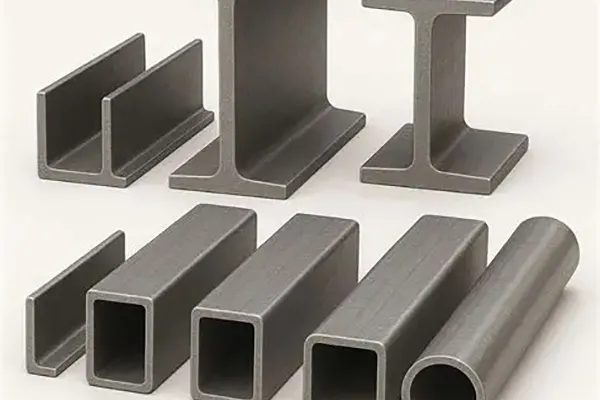
  • H Beam: Features a central web and two relatively wide flanges. Common applications include building columns, beams and heavy structural frames.
  • I Beam: Has an I-shaped cross-section, generally with proportions that differ from common H-section series. It is used in buildings, bridges and industrial structures.
  • U Channel: Consists of a web and two flanges forming a U-shaped section. It is commonly used in support frames, equipment structures and secondary steelwork.
  • Angle Steel: Has two legs arranged at approximately 90 degrees. Equal-leg and unequal-leg angles are used in bracing, towers, supports and fabricated assemblies.
The distinction between H beams and I beams depends on their cross-sectional proportions and the applicable section series. Product names alone are not sufficient for identifying dimensions. Buyers should confirm the exact section designation, steel grade and dimensional standard.

2. How Does the Structural Steel Profile Manufacturing Process Work?

The manufacturing route depends on the profile design, dimensions, steel grade and production facility. Standard structural sections are commonly hot rolled, while certain products are fabricated from steel plates or produced by cold forming.
  • Steel Billet or Bloom Preparation: Hot rolling usually starts with a suitable semi-finished product, such as a billet, bloom or beam blank. Its chemical composition and material identification should meet the requirements for the intended steel grade. Surface condition and traceability are also checked before further processing.
  • Reheating: The semi-finished steel is heated in a reheating furnace until it reaches a temperature suitable for rolling. The required temperature depends on the steel grade, section size and rolling schedule. Insufficient heating can make deformation more difficult, while excessive heating may contribute to oxidation, grain growth or surface quality problems.
  • Rolling and Section Formation: The heated material passes through a series of rolling stands. Each pass progressively changes its cross-section until the required profile is formed. H beams and I beams are commonly produced using specialized rolling stands with horizontal and vertical rolls. These rolls shape the web and flanges through successive passes. U channels and angle steel are formed using suitable roll grooves and pass sequences designed for their respective cross-sections. Roll design, alignment and process control influence flange geometry, web thickness, section dimensions and surface condition.
  • Cooling and Straightening: After rolling, profiles are transferred to a cooling bed or another suitable cooling system. The cooling route depends on the steel grade, section dimensions and production requirements. Certain specialized products may require additional cooling controls to achieve specified mechanical properties. Straightening may then be carried out to correct dimensional deviations caused by rolling and cooling. The profiles are cut to the required lengths before final inspection.

3. How Are Structural Steel Profiles Inspected?

Inspection requirements should follow the purchase order, applicable product standard and project specification. Typical checks include:

Profile

Main dimensional checks

H Beam

Section height, flange width, web thickness and flange thickness

I Beam

Section height, flange width, web thickness and flange thickness

U Channel

Section height, flange width, web thickness and flange geometry

Angle Steel

Leg dimensions, thickness, included angle and straightness

Other inspection items may include:
  • Length and straightness: Overall length, camber, sweep and specified dimensional tolerances.
  • Surface condition: Visible cracks, laps, seams, scale and other surface imperfections.
  • Material identification: Steel grade, heat number and product traceability.
  • Mechanical properties: Yield strength, tensile strength and elongation where required.
  • Chemical composition: Verification against the material specification through certificates or specified testing.
For example, EN 10034 specifies dimensional and shape tolerances for structural steel I and H sections within its scope. Angle steel and channel sections have their own applicable dimensional standards. The correct standard and edition should be confirmed for each product. Not every project requires the same inspection scope. Sampling frequency, acceptance criteria and additional testing should be agreed in the inspection and test plan.

4. Why Do Manufacturing Controls Matter?

Manufacturing deviations can affect fabrication, connection preparation and site installation. Incorrect flange dimensions may complicate bolted or welded connections, while excessive straightness deviations can create alignment problems during assembly. Buyers should therefore confirm more than the profile name and nominal size. Steel grade, manufacturing route, dimensional tolerances, delivery condition and inspection documentation should all match the project requirements.

5. What Should Buyers Confirm Before Ordering?

A complete inquiry should include the profile type, section designation, steel grade, applicable standard, required length, quantity and delivery destination. For project orders, buyers should also clarify material certificate requirements, third-party inspection, marking, bundling, cutting requirements and export packing. Any special dimensional tolerances or fabrication requirements should be agreed before production.

FAQ

Q1: Are H beams and I beams manufactured using the same process?
A1: Both are commonly produced by hot rolling, but their cross-sectional designs, roll configurations and dimensional requirements may differ.

Q2: Is angle steel always equal-leg?
A2: No. Angle steel is available in both equal-leg and unequal-leg configurations.

Q3: Are all structural steel profiles manufactured by hot rolling?
A3: No. Hot rolling is widely used for standard structural sections, but fabricated and cold-formed sections are also used for certain dimensions and applications.

Q4: Which factors affect structural steel profile quality?
A4: Material composition, reheating, rolling control, cooling, straightening and final inspection all influence product quality.

Q5: What documents should accompany structural steel profiles?
A5: Depending on the order, documents may include material test certificates, inspection records, packing lists and commercial invoices. Project-specific documentation should be agreed before production.

Q6: Can structural steel profiles be supplied in customized lengths?
A6: Cut-to-length supply may be available depending on the profile, production source and order requirements. Buyers should confirm the required length and tolerance before ordering.

Structural Steel Profile Supply for Construction Projects

Hunan Great Steel Pipe Co., Ltd. supports international structural steel supply through specification review, sourcing coordination, inspection arrangements, documentation review and export delivery coordination. Supply details are confirmed against the required profile dimensions, material grade and project specifications. 

Latest news list

  • FBE coated steel pipe inspection and maintenance,FBE pipeline maintenance,steel pipe coating inspection,FBE coating defects
    FBE (fusion-bonded epoxy) coating provides external corrosion protection for steel pipelines,particularly in buried and submerged applications,However,the coating does not eliminate the need for inspection after installation,Construction damage,field joint defects,ground movement and third-party excavation can affect the protective system during pipeline service,For buried pipelines,most of the external coating cannot be examined directly without excavation,Operators therefore need a planned integrity management approach that combines construction records,accessible-area inspections,corrosion monitoring and targeted investigation of suspected defects,
  • FBE steel pipe export supply,FBE steel pipe export,FBE pipe shipment,international steel pipe supplier
    Exporting FBE coated steel pipes for an overseas pipeline project involves more than arranging production and booking shipment,The order must move through several connected stages,from technical specification review and pipe sourcing to coating coordination,inspection,documentation and delivery,Each stage needs to follow the approved purchase requirements,A mismatch in pipe specifications,coating details,inspection records or shipping documents can delay acceptance and affect the project schedule,A clear coordination process helps buyers maintain control over these details before the goods leave the country of origin,
  • prevent FBE steel pipe coating,FBE pipe handling,FBE coated pipe transportation,FBE coating repair,FBE steel pipe coating inspection
    Fusion-bonded epoxy (FBE) coating provides external corrosion protection for steel pipes used in steel pipeline systems,However,even a properly applied coating can be damaged after leaving the coating facility,Scratches,impact marks,and abrasion may occur during lifting,transportation,storage,or installation,potentially exposing the steel surface to corrosion,Preventing this damage requires more than careful handling at one stage,Protection should be considered throughout the supply and construction process,from loading and delivery to trench installation and final inspection,
  • buying FBE steel pipe internationally,FBE steel pipe supplier,FBE coated pipe procurement,FBE pipe export purchasing
    Buying FBE coated steel pipe from an overseas supplier involves more than comparing prices,Buyers need to confirm the base pipe specifications,coating requirements,inspection arrangements,shipping terms and delivery schedule before placing an order,A low quotation may not represent the best value if important technical requirements or destination costs have been left out,
  • FBE steel pipe field joint coating,FBE pipe welding protection,field joint coating,FBE coating repair,FBE field joint inspection
    FBE (fusion-bonded epoxy) coating provides external corrosion protection for steel pipes used in pipeline projects,However,during pipeline construction,the coating near pipe ends must be protected while individual pipe sections are joined by welding,The exposed joint area then requires a suitable field joint coating system,If this work is not properly controlled,damage or poor bonding at the joint can compromise the continuity of the pipeline's corrosion protection,Protecting the factory coating and applying the correct field joint system are therefore important parts of pipeline construction,

Find what you need ?

close
We use cookies and other tracking technologies to improve your browsing experience on our website, to show you personalized content and targeted ads, to analyze our website traffic, and to understand where our visitors are coming from.