Industry News

Hunan Great Steel Pipe Co., Ltd
steel pipe coating process,coated steel pipe,steel pipe coating,FBE coated steel pipe,epoxy coated steel pipe

How Is Coating Applied to Steel Pipe and How Do You Choose the Right Coating

Date: 2026-08-12
Steel pipe coating is more than simply adding a protective layer to the pipe surface. The final performance depends on surface preparation, coating material, application conditions, curing, inspection, and handling. For engineering projects, coating selection should start with the service environment. A buried pipeline may require different protection from an above-ground water line, marine facility, or industrial piping system. A well-designed coating system reduces contact between steel and corrosive elements such as moisture, oxygen, chemicals, and salts. However, coating is only one part of corrosion control. Material selection, cathodic protection, installation practices, and maintenance may also need to be considered.


How Is Coating Applied to Steel Pipe?

Although the exact procedure varies by coating system, plant-applied steel pipe coating generally follows several controlled stages.

1. Surface Preparation

Before coating, the steel surface must be cleaned and prepared. Oil, grease, rust, mill scale, dust, soluble salts, and other contaminants can interfere with coating adhesion.

Abrasive blast cleaning is commonly used to produce the required surface cleanliness and profile. AMPP emphasizes that proper surface preparation is fundamental to coating performance because contamination or an unsuitable surface profile can lead to premature coating failure. For pipeline projects, the required preparation grade should be specified by the project and coating system rather than assumed by the supplier.


2. Heating and Coating Application

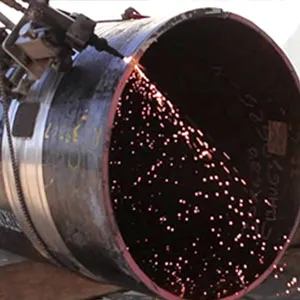
Some systems require the steel pipe to be heated to a controlled temperature before application. For fusion-bonded epoxy (FBE), epoxy powder is applied to the heated steel surface. The powder melts and cures to form a continuous protective layer. Application temperature, powder characteristics, coating thickness, and line speed must be controlled according to the qualified procedure. AMPP’s FBE guidance specifically covers application and inspection of plant-applied FBE systems, highlighting the importance of process control throughout the coating operation.


3. Multi-Layer Coating

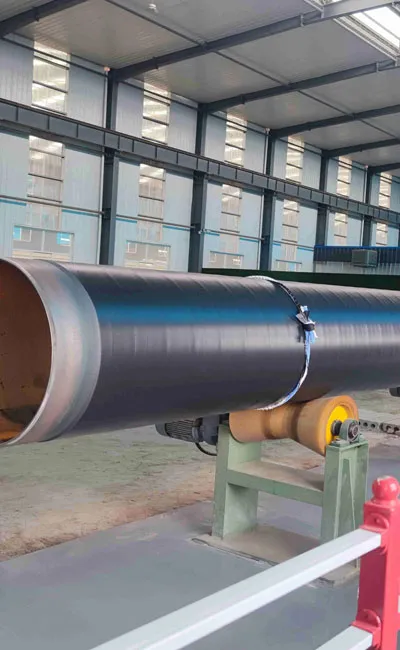
For 3LPE and 3LPP, protection comes from several layers working together: FBE primer → adhesive layer → PE or PP outer layer. 
The epoxy layer provides corrosion protection and adhesion. The adhesive bonds the layers, while the outer polyolefin layer provides additional mechanical and environmental protection.

ISO 21809-1:2018 specifies requirements for plant-applied three-layer PE and PP external coatings for buried or submerged steel pipelines used in petroleum and natural gas transportation systems. In 2026, ISO 21809-4:2026 was also published for plant-applied 2-layer polyethylene coatings, covering qualification, application, inspection, testing, handling, and storage.


4. Cooling, Curing and Final Inspection

After application, the coating must reach the required cured or cooled condition before further handling.
Inspection may include:
  • Visual surface inspection
  • Coating thickness measurement
  • Holiday or discontinuity detection
  • Adhesion testing where specified
  • Coating integrity checks
  • Repair of damaged areas
The inspection requirements should be defined by the applicable coating specification and project documents.

Which Coating Material Should You Choose?

Different coating materials solve different engineering problems.

Coating

Main Strength

Typical Consideration

FBE

Strong adhesion and corrosion protection

Buried pipelines

2LPE

Polyethylene-based external protection

Specified buried/submerged pipeline systems

3LPE

Corrosion and mechanical protection

Buried/submerged pipelines

3LPP

Polypropylene outer protection

Applications requiring suitable higher-temperature performance

Epoxy

Adhesion and chemical resistance

Industrial and water applications

Polyurethane

Toughness and abrasion resistance

Industrial and exposed service

Hot-Dip Galvanizing

Barrier and sacrificial zinc protection

Atmospheric and outdoor applications

These are general guidelines. The correct coating depends on temperature, corrosion exposure, mechanical loading, installation conditions, coating thickness, and project specification.
When Should FBE, 3LPE or 3LPP Be Considered?

FBE is a practical option when strong adhesion and corrosion protection are required. It is widely used for pipeline applications and can be used as part of a broader corrosion-control system.
3LPE adds a polyethylene outer layer that provides additional mechanical protection, making it suitable for many buried and submerged pipeline applications.
3LPP uses polypropylene as the outer layer and may be considered where the service conditions require higher temperature capability than a particular PE system can provide.
The choice between PE and PP should therefore be based on actual operating temperature, installation conditions, mechanical exposure, and the governing specification.

Why Do Steel Pipe Coatings Fail?

A coating can fail even when the selected material is technically suitable.
Common causes include:
  • Inadequate surface preparation
  • Oil, dust, salt, or moisture contamination
  • Incorrect application temperature
  • Improper coating thickness
  • Incomplete curing
  • Mechanical damage during handling
  • Damage during transportation or installation
In practice, many coating problems originate before the coating itself is applied. This is why surface preparation, process control, and inspection should be treated as one quality-control chain.

How Should Buyers Select a Coating?

Before ordering coated steel pipe, confirm:
1. Environment: Is the pipe buried, submerged, marine, indoor, or outdoor?
2. Temperature: What are the minimum and maximum operating temperatures?
3. Internal medium: Is internal corrosion also a concern?
4. Mechanical exposure: Will the coating face impact or abrasion?
5. Service life: How long must the corrosion-control system perform?
6. Standard: Which product and coating specification applies?
7. Inspection: What thickness, holiday detection, adhesion, or other tests are required?
The most suitable coating is not necessarily the most expensive one. It is the system that matches the actual service conditions and required design life.

Conclusion

Steel pipe coating is a controlled manufacturing process that begins with surface preparation and continues through application, curing, inspection, repair, and careful handling. FBE, 2LPE, 3LPE, 3LPP, epoxy, polyurethane, and hot-dip galvanizing each have different performance characteristics. The right selection depends on the steel pipe, operating environment, temperature, installation method, corrosion risk, and applicable specification. Hunan Great Steel Pipe Co., Ltd. provides coated steel pipe solutions with customized coating, inspection, packaging, and export requirements for international engineering projects.

Latest news list

  • API 5L X52 seamless pipe,3LPE coated steel pipe,coated carbon steel pipe,API 5L steel pipe
    Reliable pipeline construction depends on more than simply supplying steel pipe,Material grade,pipe dimensions,manufacturing process,corrosion protection,inspection,and delivery coordination all need to match the project requirements,
  • coated vs uncoated steel pipe,coated steel pipe,uncoated steel pipe,steel pipe corrosion protection
    When selecting steel pipe for an industrial or infrastructure project,one of the first questions is whether the pipe should be supplied with a protective coating,Coated and uncoated steel pipes can both be suitable,but the right choice depends on the service environment,corrosion risk,design life,maintenance strategy,and project specification,
  • how to inspect coated steel pipe,coated steel pipe inspection,coated steel pipe quality control
    A coated steel pipe should not be accepted simply because its surface looks smooth and uniform,Proper inspection needs to cover both the steel pipe and the protective coating system,from raw material verification through final packaging,For oil and gas pipelines,water transmission systems,industrial piping,and infrastructure projects,coating defects can expose steel to moisture and corrosive environments,A practical inspection process therefore checks the base pipe,surface preparation,coating application,thickness,continuity,documentation,and handling,
  • how to choose coated steel pipe,coated steel pipe quality,anti-corrosion steel pipe,coated steel pipe supplier
    Choosing a coated steel pipe is not simply a matter of selecting a coating name such as 3PE,FBE,epoxy,or galvanized,The quality of the finished product depends on the base pipe,surface preparation,coating system,application process,inspection,and handling,
  • coated steel pipe,coated steel pipe types,coated steel pipe applications,steel pipe coating
    Coated steel pipe is steel pipe with a protective layer applied to its external surface,internal surface,or both,The primary purpose is to reduce corrosion and protect the pipe from the environment or transported medium,

Find what you need ?

close
We use cookies and other tracking technologies to improve your browsing experience on our website, to show you personalized content and targeted ads, to analyze our website traffic, and to understand where our visitors are coming from.