Product News

Hunan Great Steel Pipe Co., Ltd
coated steel pipe,coated steel pipe applications,coated steel pipe benefits,coated carbon steel pipe

Why Is Coated Steel Pipe Widely Used in Industrial Projects

Date: 2026-08-13
Industrial piping is often exposed to conditions that can accelerate corrosion, including moisture, soil, chemicals, salts, and outdoor environments. For many projects, using bare carbon steel without additional protection can increase maintenance requirements and shorten the expected service life of the piping system. This is why coated steel pipe is widely used in pipelines, petrochemical facilities, water infrastructure, power projects, mining operations, and other industrial applications. The basic principle is straightforward: the steel pipe provides the required structural and mechanical performance, while the coating creates a protective barrier between the steel surface and the surrounding environment. The effectiveness of this approach depends on selecting the right coating, preparing the steel surface correctly, and controlling the application and inspection process.

1. It Provides an Additional Barrier Against Corrosion

External corrosion is one of the primary reasons industrial steel pipe requires protection. Buried pipelines can be exposed to moisture and corrosive soil. Above-ground piping may face rain, humidity, industrial contaminants, or marine atmospheres. In chemical and petrochemical facilities, the surrounding environment can be even more demanding. A properly selected coating separates the steel surface from these external conditions and helps reduce direct exposure. This makes coated steel pipe particularly suitable for:
  • Oil and gas pipelines
  • Water transmission systems
  • Chemical and petrochemical plants
  • Power facilities
  • Mining infrastructure
  • Marine and coastal projects
  • Industrial utility systems
For buried or submerged pipelines, ISO 21809-1:2018 specifies requirements for plant-applied three-layer polyethylene and polypropylene external coatings for corrosion protection of welded and seamless steel pipe used in petroleum and natural gas transportation systems.

2. The Coating Can Add Mechanical Protection

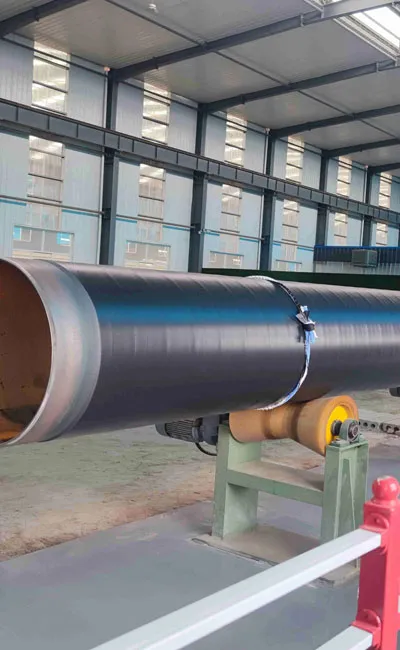
Industrial pipe does not only face chemical or atmospheric exposure. During transportation, handling, installation, and backfilling, the external surface can also be exposed to impact and abrasion. Some coating systems provide an additional layer of mechanical protection. For example, a 3LPE system combines fusion-bonded epoxy, an adhesive layer, and a polyethylene outer layer. Each layer performs a different function within the overall coating system, helping provide corrosion protection, adhesion, and external protection. This makes multi-layer systems attractive for pipelines where both corrosion and handling damage need to be considered. The coating should not, however, be treated as indestructible. Proper lifting, storage, transportation, field installation, and coating repair remain essential to protecting the finished pipe.

3. It Can Support Long-Term Asset Protection

For a major industrial project, the cost of corrosion is not limited to replacing a section of pipe. Unexpected corrosion can lead to inspection, maintenance, shutdown, excavation, repair, replacement, and recommissioning costs. A suitable coating system can help protect the underlying steel and reduce exposure to external corrosion throughout the intended service period. The important qualification is “suitable and properly applied.” Coating performance depends on the service environment, surface preparation, coating system, application conditions, inspection, and subsequent handling. Therefore, industrial buyers should evaluate the complete coating system rather than choosing a product simply because it is described as “corrosion resistant.”

4. Different Coating Systems Suit Different Applications

One reason coated steel pipe is widely used is the range of available coating technologies. Common options include:

Coating System

Typical Application Consideration

FBE

Corrosion protection and strong adhesion

2LPE

External protection for specified pipeline applications

3LPE

Corrosion and mechanical protection

3LPP

Higher-temperature applications where specified

Epoxy

Industrial and selected chemical environments

Polyurethane

Applications requiring toughness and abrasion resistance

Hot-Dip Galvanizing

Atmospheric and outdoor corrosion protection

The selection should consider operating temperature, soil or water conditions, chemical exposure, installation method, mechanical damage risk, and required service life. For example, ISO 21809-4:2026 now specifies requirements for plant-applied two-layer polyethylene coatings, including qualification, application, inspection, testing, handling, and storage. This illustrates an important procurement principle: the coating should be selected according to the project conditions, not simply according to what is most commonly available.

5. Factory Coating Allows Better Process Control

For large industrial orders, coating in a controlled production environment can provide important quality advantages. A typical coating process may involve:
Steel pipe inspection → surface preparation → coating application → curing/cooling → coating inspection → repair if required → final inspection → packaging.
Each stage affects the final result. Surface preparation is particularly important because contaminants, inadequate cleanliness, or an unsuitable surface profile can affect coating adhesion. Factory production also makes it easier to control coating thickness, application conditions, inspection procedures, and product traceability before the pipe leaves the manufacturing facility. For international projects, this controlled process can be especially valuable because finished coated pipe may subsequently face long-distance transportation and multiple handling stages.

6. It Can Help Control Life-Cycle Costs

Coated steel pipe may have a higher initial purchase price than an equivalent uncoated pipe. That does not necessarily make it the more expensive solution over the complete project life. A more useful comparison considers: Material cost + coating cost + installation + maintenance + expected service life + potential replacement cost. When corrosion protection reduces the frequency of external corrosion-related maintenance or replacement, the overall economics can become more favorable. For long-term industrial assets, procurement decisions should therefore consider life-cycle performance rather than unit price alone.

7. When Should an Industrial Project Consider Coated Steel Pipe?

Coated steel pipe is particularly worth considering when the project involves:
  • Buried pipelines exposed to soil and moisture
  • Marine or coastal facilities exposed to salt and humidity
  • Outdoor piping exposed to atmospheric corrosion
  • Chemical facilities with aggressive surrounding environments
  • Long-distance pipelines requiring durable external protection
  • Projects with high handling or abrasion risks
The coating system should still be matched to the actual service conditions rather than selected solely by application category.

8. What Determines the Final Coating Performance?

A coating material alone does not determine the quality of coated steel pipe. Project teams should also consider:
  • Steel pipe grade and specification
  • Surface preparation
  • Coating type and thickness
  • Application conditions
  • Adhesion
  • Holiday/discontinuity detection
  • Repair procedures
  • Final inspection
  • Packaging and transportation
This is why a reliable coated steel pipe supply chain involves more than purchasing the coating material. Pipe manufacturing, coating, inspection, packaging, and logistics need to be controlled as one process.

Conclusion

Coated steel pipe is widely used in industrial projects because it combines the strength and structural performance of steel with additional protection against external corrosion and environmental exposure. Its advantages are particularly relevant to buried pipelines, water infrastructure, chemical facilities, energy projects, marine environments, and other applications where corrosion control is an important part of asset reliability. However, there is no universally suitable coating. The right solution depends on the steel pipe specification, operating temperature, environmental exposure, installation conditions, coating system, inspection requirements, and expected service life. Hunan Great Steel Pipe Co., Ltd. supplies coated carbon steel pipe for international engineering projects, supporting customers with pipe specifications, coating requirements, quality inspection, documentation, packaging, and export coordination. Planning a coated steel pipe project? Send us your pipe grade, dimensions, application environment, coating requirement, quantity, and applicable standard for a technical review and quotation.

Latest news list

  • coated steel pipe procurement,how to buy coated steel pipe,coated steel pipe inspection,coated steel pipe
    Buying coated steel pipe is not simply a matter of comparing prices and selecting a pipe diameter,For an engineering project,the steel pipe,coating system,service environment,inspection requirements,and delivery conditions must all work together,A coating that is suitable for one pipeline may not be appropriate for another,Similarly,a technically compliant pipe can still create problems if the coating is poorly applied,damaged during transportation,or supplied without adequate inspection records,For procurement teams,checking the following points before placing an order can help reduce technical risk and avoid unexpected costs,
  • API 5L X52 seamless pipe,3LPE coated steel pipe,coated carbon steel pipe,API 5L steel pipe
    Reliable pipeline construction depends on more than simply supplying steel pipe,Material grade,pipe dimensions,manufacturing process,corrosion protection,inspection,and delivery coordination all need to match the project requirements,
  • steel pipe coating process,coated steel pipe,steel pipe coating,FBE coated steel pipe,epoxy coated steel pipe
    Steel pipe coating is more than simply adding a protective layer to the pipe surface,The final performance depends on surface preparation,coating material,application conditions,curing,inspection,and handling,For engineering projects,coating selection should start with the service environment,A buried pipeline may require different protection from an above-ground water line,marine facility,or industrial piping system,
  • coated vs uncoated steel pipe,coated steel pipe,uncoated steel pipe,steel pipe corrosion protection
    When selecting steel pipe for an industrial or infrastructure project,one of the first questions is whether the pipe should be supplied with a protective coating,Coated and uncoated steel pipes can both be suitable,but the right choice depends on the service environment,corrosion risk,design life,maintenance strategy,and project specification,
  • how to inspect coated steel pipe,coated steel pipe inspection,coated steel pipe quality control
    A coated steel pipe should not be accepted simply because its surface looks smooth and uniform,Proper inspection needs to cover both the steel pipe and the protective coating system,from raw material verification through final packaging,For oil and gas pipelines,water transmission systems,industrial piping,and infrastructure projects,coating defects can expose steel to moisture and corrosive environments,A practical inspection process therefore checks the base pipe,surface preparation,coating application,thickness,continuity,documentation,and handling,

Find what you need ?

close
We use cookies and other tracking technologies to improve your browsing experience on our website, to show you personalized content and targeted ads, to analyze our website traffic, and to understand where our visitors are coming from.