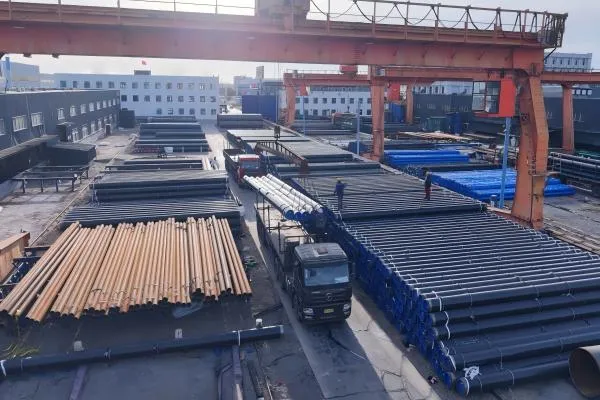
Hunan Great Steel Pipe Co., Ltd provides services that reduce total project cost and keep complex piping systems on schedule. Including Cutting, Rolling and Bending, Coating, Beveling, Threading, Welding and Assembly Forming.
For global steel stockists and traders,profit hinges on seizing market bottom prices and fast delivery resources,This month,we launch an exclusive limited-time flash promotion for large diameter welded steel pipes,Unbeatable factory bottom prices,full specifications and ultra-fast shipment create a rare stocking chance you cannot miss,
Global maritime shipping instability and rising freight costs have greatly affected international steel trade in recent years,Many overseas orders are delayed or blocked due to complex logistics and regional uncertainties,To avoid market risks and create stable supply channels for global clients,we have adjusted our global trade strategy,We build overseas warehouse networks and set up a professional international procurement team to support steady order delivery,Focusing on long-term and stable development,we are actively following the Belt and Road Initiative and shifting our focus to Central Asian markets,These inland markets are less affected by sea shipping risks and have huge potential in energy and infrastructure construction,After long-term market cultivation,we have accumulated stable local client resources and rich project service experience in Central Asia,
Three ways to ensure smoothness as required when producing straight seam steel pipe1. Rolling mold: The general method of rolling mold is to press the glass powder into a glass mat
Proper pipe spool maintenance is essential for extending service life,preventing leaks,reducing unplanned shutdowns,and maintaining the integrity of industrial piping systems,A complete maintenance program typically includes routine visual inspection,corrosion protection,flange and weld inspection,support verification,periodic non-destructive testing (NDT),and maintenance record management,When these practices are performed according to the operating environment and applicable industry standards,pipe spools can deliver reliable performance throughout their design life,
EPC contractors face three pressures: shorter schedules,tighter quality requirements,and higher labor costs,Modular construction — with pipe spools fabricated off-site — addresses all three,Shop fabrication cuts field welds by 60-80% and compresses installation schedules by 30-40%,
Pipe spools are prefabricated piping assemblies used across oil and gas,petrochemical,power generation,water treatment,and infrastructure projects,Because these assemblies are manufactured off-site and installed directly into operating systems,quality inspection is essential for ensuring safe operation,reliable performance,and efficient project execution,A comprehensive pipe spool inspection process typically includes material verification,dimensional inspection,welding quality control,non-destructive examination (NDE),hydrostatic testing,coating inspection,and final documentation review,Each stage helps identify potential issues before the spool reaches the installation site,reducing rework,project delays,and operational risks,
Pipe spools are shop-fabricated piping assemblies,They reduce field welds by 60-80% and speed up installation,But failures still happen — corrosion,vibration,thermal stress,or installation errors all take their toll,When a spool fails,the priority is two things: get the system back online,and figure out why it failed,Fixing the symptom without finding the cause guarantees a repeat failure,This guide covers common failure types,how to troubleshoot them,and what works for prevention,
Pipe spools reduce field welds by 60-80% and compress installation schedules by 30-40%,By moving fabrication from site to shop,project teams gain consistent weld quality and fewer weather delays,But a well-fabricated spool still needs proper installation — receiving checks,lifting,alignment,field welding,testing,and commissioning all affect final system performance,This guide covers the complete installation process for oil and gas,petrochemical,power generation,and industrial construction projects,
Pipe spools are shop-fabricated piping assemblies delivered to site for final tie-in,They reduce field welds by 60-80% and compress installation schedules by 30-40%,But procurement is where many projects stumble — not at fabrication,but during specification and supplier selection,This guide covers the procurement fundamentals: technical documentation,supplier capability assessment,inspection planning,corrosion protection,and logistics coordination
Pipe spools are shop‑assembled piping sections built from pipes,fittings,flanges,and welded joints,They arrive on site ready for final tie‑in — reducing field welds by 60‑80% and cutting installation schedules by 30‑40%,Oil and gas facilities,power plants,chemical processors,and water treatment projects all rely on them,
A pipe spool is a shop-fabricated assembly of pipe sections,fittings,flanges,and welded joints that is manufactured according to engineering drawings and delivered to site ready for installation,While the concept is straightforward,selecting the correct pipe spool configuration requires careful consideration of operating conditions,material performance,fabrication requirements,and inspection standards,
To address growing global demand for faster delivery,lower logistics costs and reliable supply chains,our group has officially launched a global overseas warehouse layout,with operational facilities in the United Arab Emirates (Middle East),Poland (Europe),and Brazil (South America),By establishing local stock and fulfillment centers,we enable direct local spot delivery,shorten lead times from 20–45 days to 1–3 days,reduce international logistics expenses by 30–50%,and deliver consistent,stable performance for global buyers,
A pipe spool is a prefabricated section of a piping system that includes pipes,fittings,flanges,and welded components assembled in a controlled fabrication facility before being transported to a project site for installation,Pipe spools are widely used in oil and gas,petrochemical,power generation,offshore,and industrial processing projects because they improve construction efficiency,quality control,and project scheduling,
The global steel market is becoming increasingly complex,Rising freight costs,changing tariff policies,regional trade restrictions,and geopolitical uncertainties have created new challenges for international buyers,For many importers,distributors,EPC contractors,and industrial manufacturers,maintaining a stable and cost-effective steel supply chain is no longer as straightforward as it was a decade ago,In today's business environment,relying on a single sourcing region can expose projects to unexpected risks,including supply disruptions,longer lead times,fluctuating costs,and changing trade regulations,As a result,global sourcing has become an important strategy for companies seeking greater supply-chain resilience and procurement flexibility
Stainless steel heat exchanger tubes are widely used in power generation,petrochemical processing,desalination,marine engineering,and industrial heat-transfer systems,Under proper operating conditions,these tubes can often provide 15–25 years or more of reliable service,However,premature tube failure caused by fouling,corrosion,erosion,or inadequate maintenance can significantly increase operating costs and reduce system efficiency,The good news is that most tube failures are preventable,By implementing proper maintenance strategies and selecting suitable materials,operators can extend service life,improve heat-transfer performance,and reduce unexpected downtime,
We use cookies and other tracking technologies to improve your browsing experience on our website, to show you personalized content and targeted ads, to analyze our website traffic, and to understand where our visitors are coming from.









 English
 Español
 русский язык
 Português















